You do not need a mountain, a five-hour itinerary or a cupboard full of outdoor equipment to enjoy autumn. Sometimes the ideal outing is much simpler: a proper path, a few extraordinary trees, somewhere to sit and the reasonable prospect of cake afterwards.
The difficulty is that “easy walk” can mean almost anything. A short route can still have steep steps. A garden described as accessible may have only one accessible section. And a spectacular lakeside photograph tells you very little about the climb back to the car.
This guide starts with the route, not the photograph. These four English destinations offer specific options for a gentler autumn outing, with the important limitations explained before you set off.
Featured photograph by Dan Freeman on Unsplash · View original and licence
Choose the outing, then check the route. For the shortest clearly defined option, consider Winkworth’s upper route. For an all-weather forest circuit, look at Sherwood Pines. For tree-collection variety, try Westonbirt. For reflections and garden scenery, choose Sheffield Park’s main garden paths rather than its separate estate walk.
Four walks, four different kinds of afternoon
The distances below are the operators’ descriptions. The suggested visit lengths are our planning allowances, including pauses; they are not official walking times or promises about anyone’s pace.
| Place and route | Distance or scope | Suggested time on site | Important distinction |
|---|---|---|---|
| Westonbirt, Gloucestershire | Short-walk options under one mile; seasonal Silk Wood trail approximately two miles | Two to three hours | Pick a mapped hard-surface route, not an unrestricted woodland wander |
| Sheffield Park, East Sussex | Main garden figure-of-eight; distance depends on the circuit chosen | Two to three hours | Garden accessibility does not extend to every slope or the wider estate |
| Winkworth, Surrey | Upper Arboretum Route, approximately 1km | One to two hours | The lower lakeside routes are steeper and are not equivalent alternatives |
| Sherwood Pines, Nottinghamshire | Archer’s Stroll, one mile / 1.6km | One to two hours | Follow this specific surfaced circuit, not the longer forest trails |
These are countryside and garden visits, not a blanket assurance of accessibility. Surface condition, the distance from parking and your own requirements all matter. Use the linked access information and ask the venue about anything that could determine whether the day works for you.
First, decide what “easy” needs to mean
A useful walk has to suit the person doing it. Before comparing destinations, decide whether your priority is a short distance, fewer gradients, a firm surface, frequent seats or being close to facilities.
Those are different requirements. A wheelchair user may need more detailed information about cross-slopes than someone simply seeking a shorter stroll. A family with a pushchair may be comfortable with a longer hard-surfaced route but not steps. Someone rebuilding stamina may care most about knowing where they can turn back.
Try this question instead of “Is it accessible?”: “Can you suggest a route of about an hour, without steps, with places to sit, and explain any slopes between the car park and the start?” Add your particular needs rather than relying on a general label.
Give yourself an exit plan too. Knowing you can enjoy a smaller circuit removes the pressure to complete every coloured line on the map.
1. Westonbirt: make the trees the main event
Westonbirt is a strong choice when you want autumn to be the whole point of the day. The practical advantage is its choice of routes: Forestry England describes ten miles of hard paths and a series of short walks, each under one mile. The treetop walkway is also described as accessible to wheelchairs and mobility scooters in the official access information.
For a longer option, its Perfectly Imperfect autumn trail is approximately two miles in Silk Wood, with a hard surface and an operator estimate of about 90 minutes. This is a seasonal trail, so check that it is running on your date rather than expecting permanent signs throughout the year.
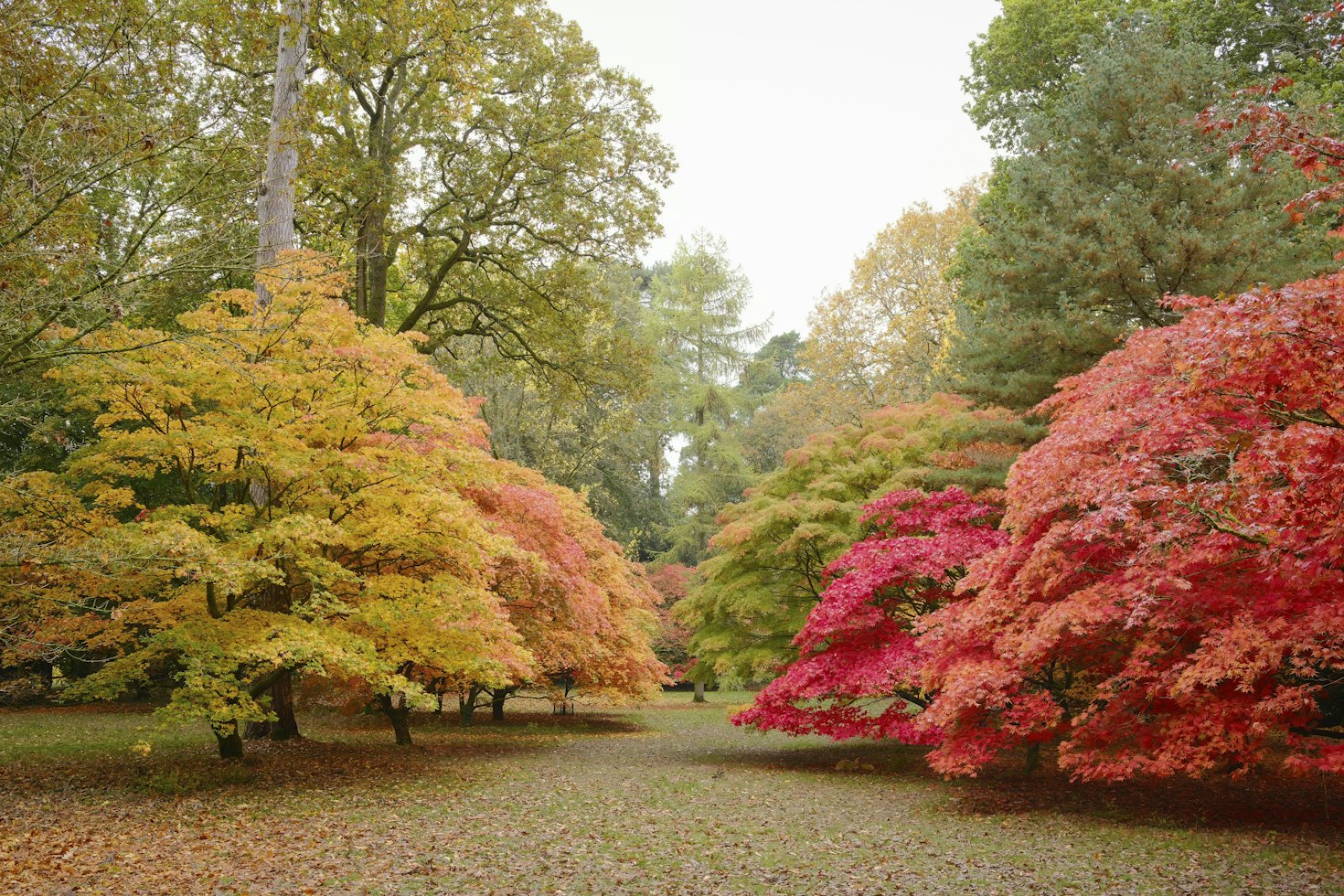
Photo by George Bale on Unsplash · View original and licence
The better way to approach Westonbirt is to choose one route and allow time to be distracted. Stop where a branch catches the light. Look back along a path. Compare a red maple with a tree that is still mostly green. There is no prize for seeing the largest number of labels.
With a dog: Silk Wood is the relevant part of the arboretum; check the current dog rules rather than assuming the Old Arboretum has the same access. The seasonal trail page specifically identifies Silk Wood as dog-friendly.
Practical finish: check admission, parking arrangements and food opening times through Westonbirt’s visitor page. Accessible parking does not remove every gradient: the official access guide notes a slope between the car park and Welcome Building.
2. Sheffield Park: choose the garden, not the estate hike
Sheffield Park’s appeal is the combination of autumn trees and water. But the most useful planning detail is a less glamorous one: the National Trust distinguishes the main garden figure-of-eight from rougher areas and unsuitable slopes.
Its autumn visitor guidance describes the main figure-of-eight as accessible, identifies other paths as unsuitable for some mobility equipment and explains where to find benches and accessible toilets. Collect the current map at reception and ask which parts best match your needs.
Do not accidentally substitute the separate three-mile estate walk. The estate route description rates that walk moderate and warns of uneven ground, mud, inclines and possible flooding. “Same property” does not mean “same difficulty”.
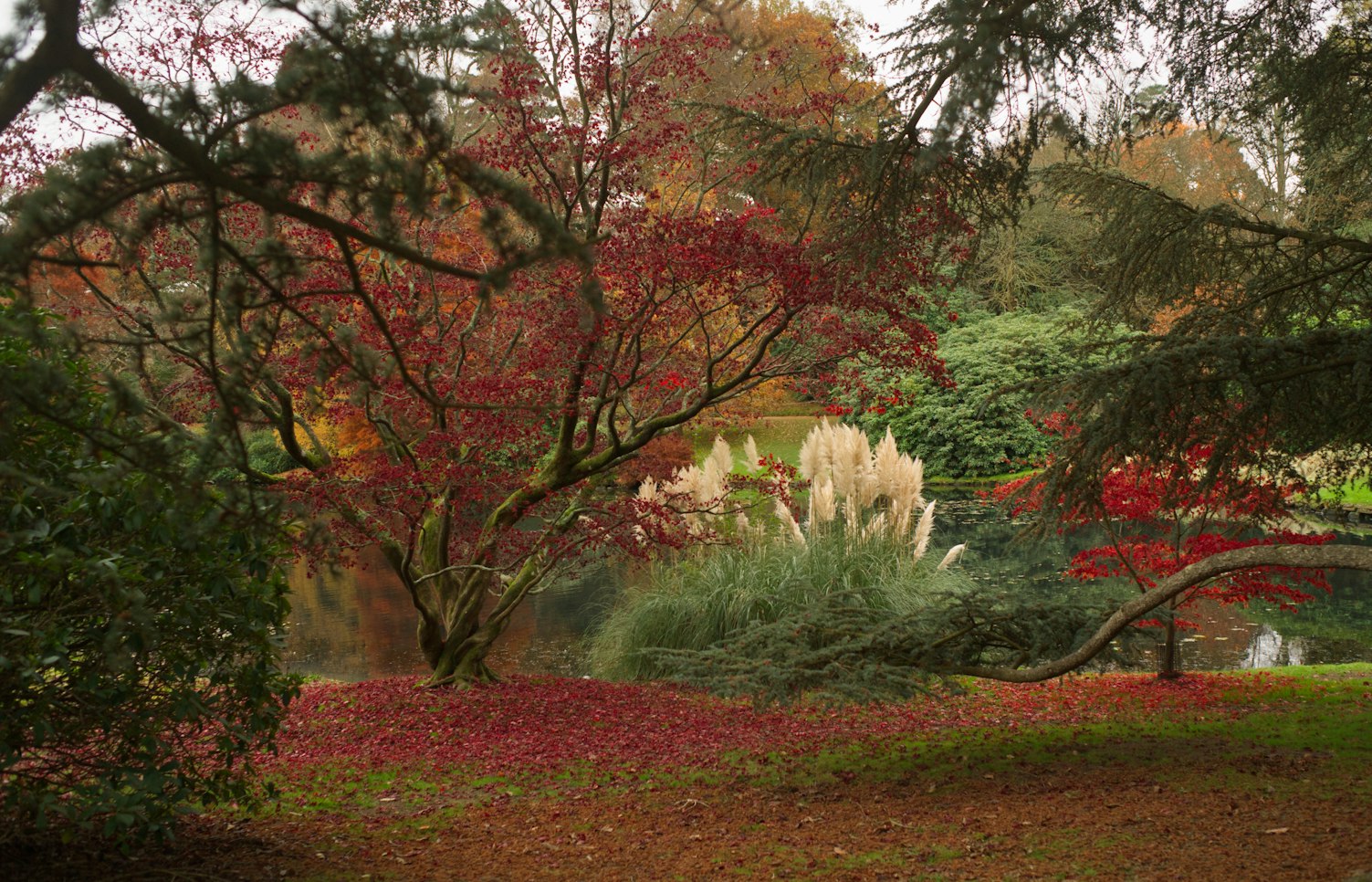
Photo by Anthony Roberts on Unsplash · View original and licence
For a relaxed visit, use one stretch of water as your destination rather than a compulsory full circuit. Spend a little time with the reflections, choose another view if you have the energy, and leave the rest for another day.
With a dog: the current dog-access rules allow dogs on short fixed leads in the garden except Saturday mornings before 1pm. Assistance dogs are welcome throughout. Recheck before travel because this is exactly the kind of detail that can change a plan.
Parking and refreshments: use the official visitor information for admission and café hours. Busy autumn days may involve overflow parking, so ask about the approach to reception if walking from the car is a concern.
3. Winkworth: a short walk that needs the right colour marker
Winkworth offers a particularly clear example of why route names matter. The Upper Arboretum Route follows blue markers for approximately 1km and is described as level and step-free.
The orange Boathouse Route is approximately 1.5km but includes steep paths and steps. The longer red route is more challenging again. An extra half-kilometre is therefore not the only difference between the blue and orange walks.
For a gentle outing, make the upper route the plan. Do not let a beautiful lake photograph quietly turn it into a different sort of day. There is nothing incomplete about enjoying the upper collection, taking your time and finishing at the café.

Photo by William Warby on Unsplash · View original and licence
Getting there matters: the main visitor page warns against walking along the main road from Godalming because it has no suitable pavement. Check the current bus service or arrange a taxi rather than interpreting a short map distance as a safe pedestrian connection.
Facilities: visitor information lists accessible toilets, a Changing Places facility and designated parking. Equipment availability and any lower-car-park access need checking with the team; they are not a reason to assume the lower paths are level.
Dogs on leads are welcome according to the things-to-see page. Check the current admission and parking charges when planning, rather than relying on last autumn’s receipt.
4. Sherwood Pines: a straightforward forest loop
For a Midlands option, Archer’s Stroll at Sherwood Pines is a one-mile circular route marked with white bands. Forestry England describes it as a gentle, all-weather trail suitable for pushchairs and wheelchairs, passing woodland, glades and seating near Dragonfly Pond.
This is a forest experience rather than a promise of uninterrupted red maples. Choose it for a manageable circuit with a defined start and finish, not because every tree will look like an autumn postcard.
Keep the route simple. The nearby three-mile Castle Walk and longer Ranger’s Path are different trails with different surfaces. A sign offering a longer option is an invitation, not an obligation.
The access guide explains that the main car park is closest to the visitor centre, with the approach varying according to where you park. It also lists benches and pre-bookable all-terrain mobility-scooter hire. Review the current parking-payment instructions before arrival.
With a dog or children: check the forest’s current facilities and visitor rules, keep to designated paths and allow enough time around other visitors. A short route with a calm stop at the café can be a complete day out rather than the first stage of something more ambitious.
When should you go for autumn colour?
There is no single perfect weekend for all four destinations. The National Trust says Sheffield Park’s colour can start in mid-September and last into mid-November, with the second half of October often a peak period. It also stresses the influence of weather and different trees changing at different times in its seasonal guidance.
Treat that as a planning window, not a guarantee. Look for recent photographs on the operator’s own channels a few days before travelling. Check the date of a post: an attractive image recirculated from last year is not a live colour report.
A slightly quieter visit with mixed green, gold and red may suit you better than the busiest advertised peak. Choose the experience you will enjoy, not just the strongest photograph.
Build an afternoon with room to change your mind
Here is an example, not a timed venue itinerary. Arrive, use the facilities and collect a map before you begin. Spend the first half-hour on the most straightforward section. At the next seat or junction, decide whether to continue, pause or turn back.
Plan lunch or a drink as part of the outing rather than a reward for completing a distance. Keep a margin before the last entry time or car-park closure. On a short autumn afternoon, a relaxed start can otherwise become a hurried finish.
For a mixed-ability group, agree the shared minimum beforehand. Anyone keen on an extra loop can arrange a clear meeting place and time without turning the whole group’s walk into a negotiation at every junction.
Keep the practicalities as simple as the walk
Work out admission, parking, transport and refreshments together. A free or shorter walk is not necessarily the cheaper day once the journey is included. Check whether your membership applies to the actual operator and attraction; do not assume all gardens or arboreta use the same scheme.
Take footwear with suitable grip, a waterproof layer, water and your downloaded route information. Keep the original map even when you are following signs. If wet leaves conceal the surface or a section looks unsuitable, choose another route rather than treating the guide as permission to press on.
Follow the Countryside Code: respect signs and other visitors, take litter home and keep dogs under effective control. Do not step into planting to improve a photograph or take woodland material home as a souvenir.
Choose one small pleasure, not a perfect day
For a final decision, ask which detail would make the outing worthwhile even if the weather is ordinary. It might be a firm one-mile circuit, a maple collection, a lake view or simply meeting a friend somewhere that is not a shopping centre.
For another historic-estate outing, read our Blenheim Palace guide. Film fans can also explore film locations that make worthwhile days out. These are different visits, not alternative accessibility recommendations.
The best gentle autumn walk leaves something in reserve: enough energy for conversation, another look at the trees and an unhurried journey home. You do not have to see everything for the day to count.
Sources and further reading
- Westonbirt: access information and short-walk options
- Westonbirt: seasonal Perfectly Imperfect trail
- Sheffield Park: autumn planning and garden access
- Sheffield Park: dog-access rules
- Winkworth: named walking routes and access
- Winkworth: arrival, facilities and current prices
- Sherwood Pines: Archer’s Stroll
- Sherwood Pines: access and parking
- GOV.UK: the Countryside Code