The Perry AI Hub

Practical AI guidance for work, business and home

Artificial intelligence is becoming part of everyday professional and personal life. The opportunity is real—but so are the questions about confidential information, accuracy, accountability, security and the way automated tools influence decisions.

The Perry AI Hub brings together practical guidance for professionals, businesses, individuals and families. It helps readers ask better questions, recognise higher-risk situations and decide when AI needs stronger human review and organisational control.

Practical UK-focused information. No exaggerated promises, automated professional conclusions or substitute for appropriate advice.

A visual overview of connected artificial intelligence tools and professional work

Choose your route

For accountants, bookkeepers and businesses

Handle client, financial, tax, employee or commercially confidential information with a structured approach to tool selection, data boundaries, verification, incidents and governance.

Explore Professional AI Guidance

For individuals and families

Understand how chatbots, screenshots, phones, wearables, smart homes and children’s online tools can reveal or combine personal information.

Explore AI at Home

Before you use an AI tool

Six issues that deserve a deliberate answer

Useful AI adoption starts with clear boundaries, proportionate verification and human accountability.

1

Client data and confidentiality

Prompts, uploads, screenshots, recordings and connected applications can contain personal or confidential information. Understand what the service receives, why it is necessary, who may access it, where it is processed, how long it is retained and whether it may be used to improve the service.

Removing a name does not automatically anonymise detailed financial, tax, payroll, health or identity information.

2

Human review and verification

Generative AI can produce fluent material that is incomplete, outdated, biased, incorrectly reasoned or fabricated. Review should reflect the consequence of error, using primary sources, recalculation, jurisdiction and date checks where appropriate.

3

Hallucinations and accuracy

Do not accept AI-generated citations, legislation, tax rules, calculations or professional conclusions without independent verification. Be cautious when an answer sounds certain without a reliable source, uses an unfamiliar authority or applies rules without confirming date and jurisdiction.

4

Choosing AI tools

Popularity is not enough. Consider purpose, information type, account controls, provider terms, training settings, retention, deletion, security, permissions, auditability, support and the consequences of error or unauthorised action.

5

Governance and policy

Identify who is responsible, which services and accounts are approved, what information may be used, which tasks need prior assessment, how results are reviewed and how unusual outputs or suspected disclosures are escalated.

6

Security and professional responsibility

An assistant that drafts text is different from a system that can send email, alter records, move money, submit forms or connect to other systems. More powerful access requires stronger controls. Responsibility remains with people.

A useful pause point: If you cannot explain where the information goes or what the provider may do with it, do not treat the proposed use as routine.
Proportionate control: The more sensitive the information, significant the decision or powerful the AI’s access, the stronger the review and controls should be.

Client Data & AI

Turn awareness into a structured working approach

The Professional AI Guide is an implementation resource for accountants, bookkeepers and businesses that want more than general warnings. It supports more consistent assessment, documentation, incident response and repeatable review.

Professional AI Guide — £17.99

Controlled review: Purchasing is not enabled. The guide and product will remain under review until the file, licence, sales terms, cancellation wording, privacy position, checkout acknowledgements and payment configuration are approved.

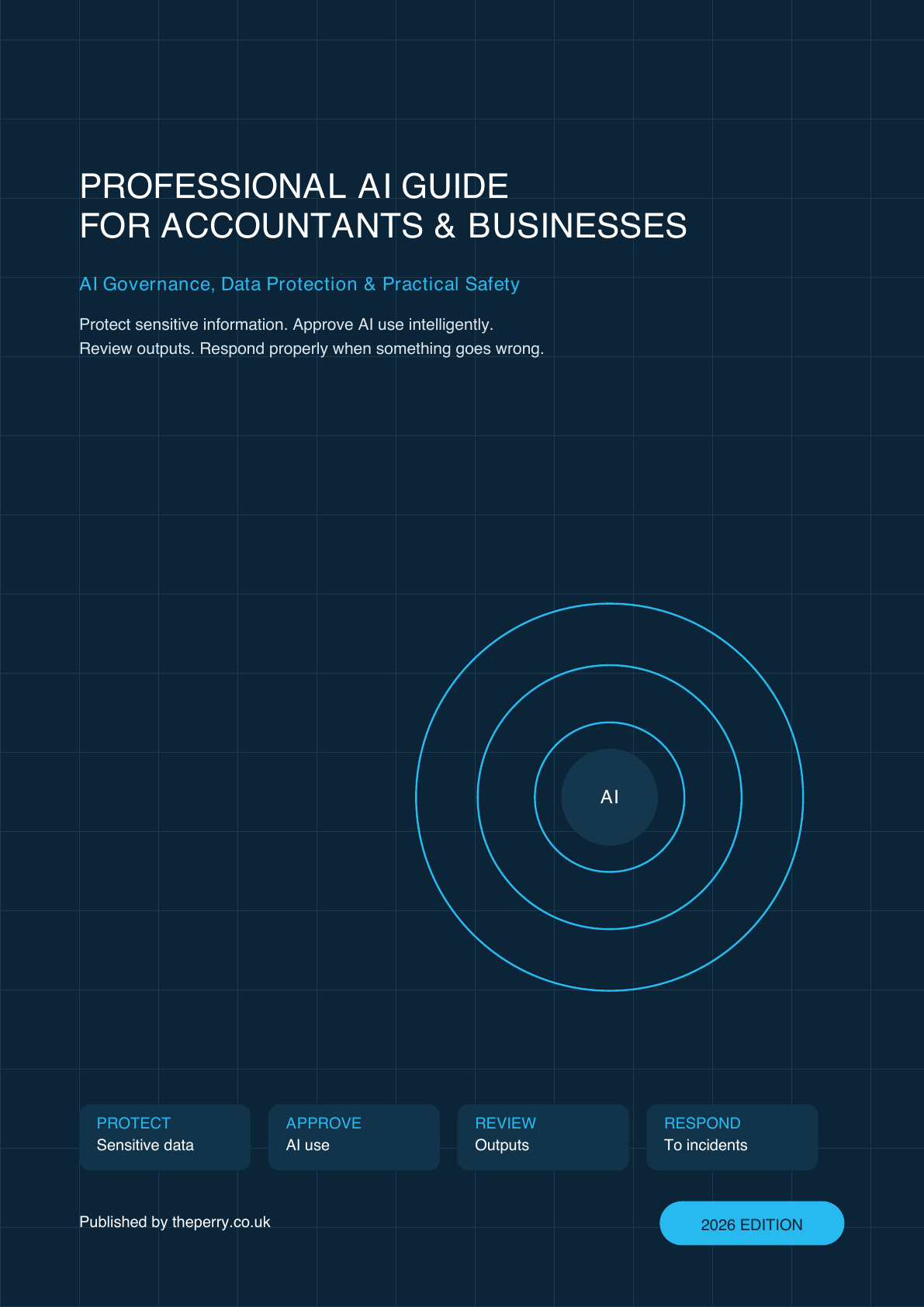
Illustrative cover treatment for controlled review. No paid guide content is displayed.

What the full guide contains

  • Structured five-gate assessment
  • GO/CHECK/STOP decision support
  • Ten worked professional scenarios
  • Detailed tool and automation controls
  • Visual incident-response timeline
  • 72-hour decision pathway
  • 30-day implementation roadmap
  • Quarterly AI-use review framework
  • Editable policy, assessment and recording resources

It does not replace professional judgement, organisational policy, legal advice, specialist data-protection advice or cybersecurity support.

Free professional introduction

Get the Free Professional AI Lite Guide

The Lite Guide introduces the core questions professionals and small businesses should ask before using generative AI at work.

  • Plain-language GO/CHECK/STOP introduction
  • Five questions to ask before using a tool
  • A starting point for protecting client and personal information
  • Accuracy and human-review reminders
  • A short first-actions checklist
  • Authoritative further reading

What the Lite Guide deliberately does not include

The full Professional AI Guide adds structured decision rules, worked scenario outcomes, the detailed incident pathway, a 30-day roadmap, quarterly review and editable resources.

For individuals and families

AI at Home: A Practical Privacy Guide for Modern Life

Practical checks for chatbots, photos, screenshots, smart homes, phones, wearables, children, health information and working from home.

The approved final guide will be available as a free direct PDF download with no email address, account, checkout or newsletter subscription required. The PDF is not attached during controlled review.

Explore AI at Home
A household privacy illustration showing connected devices and protected personal information

Continue learning

Practical AI articles from The Perry

Overview of AI in accounting and bookkeeping

AI in Accounting and Bookkeeping: A Practical Guide for UK Businesses

Where AI adds value, what must remain under human control and how client data should be protected.

Read the practical guide
Visual representing client-data confidentiality and privacy controls

Client Data, Confidentiality and AI: A Risk Checklist for Accountants

Know what leaves your systems, why it is processed, where it goes and who remains accountable.

Read the risk checklist
Visual representing professional skills and human judgement

Will AI Replace Accountants and Bookkeepers? The Skills That Matter Next

Why accountability, judgement, communication and control design become more valuable.

Explore the skills that matter
Visual representing controlled bookkeeping automation

AI Bookkeeping Automation: Saving Time Without Losing Control

Practical approval, exception and review controls for invoice capture, coding and reconciliation.

Read about automation controls
Visual representing forecasting and professional analysis

From Bookkeeping to Better Decisions: AI Forecasting and Advisory Work

Useful forecasts still depend on clean data, transparent assumptions and professional understanding.

Read about forecasting and advisory work

Choose what you receive

Email updates matched to your interests

Email preferences are being prepared and are not yet open to subscribers. The controlled setup will support multiple selections, double opt-in, deduplicated sends, preference management and unsubscribe links.

Receive all updatesAI & TechnologyProfessional & PracticeTax & ComplianceAccounting & BookkeepingBusiness & FinancePersonal AI & Digital Life

No live Brevo form is embedded on this draft.

Important information: The Perry’s AI material provides general educational information. It does not provide individual accounting, tax, legal, medical, data-protection or cybersecurity advice. AI tools, provider terms, laws, professional guidance and technical settings can change. Check current authoritative information and obtain appropriate advice for significant decisions.