

If you are a sole trader or landlord, your 2025–26 income may decide whether you must use Making Tax Digital (MTD) for Income Tax from 6 April 2027. The key figure is gross income from self-employment and property, before expenses. It is easy to look at profit, one business at a time, or an HMRC letter and reach the wrong answer.
This guide is for people planning for the 2027 entry group. The Perry has a separate first-year checklist for those who entered in 2026. The underlying system is similar, but your start year and tax return dates differ.
The short answer: If your qualifying income on your 2025–26 Self Assessment return is more than £30,000, and you meet the other conditions, MTD for Income Tax starts for you on 6 April 2027. Exactly £30,000 is not “more than £30,000”. The rule concerns qualifying income, not taxable profit. Check your position with HMRC.
1. Check the threshold with the right income
Add gross receipts from all your self-employment and property sources before deducting expenses. A sole trader with £22,000 of sales and £12,000 of gross rents has £34,000 of qualifying income, even if each source alone is below £30,000. If there is more than one trade or rental business, check the combined figure.
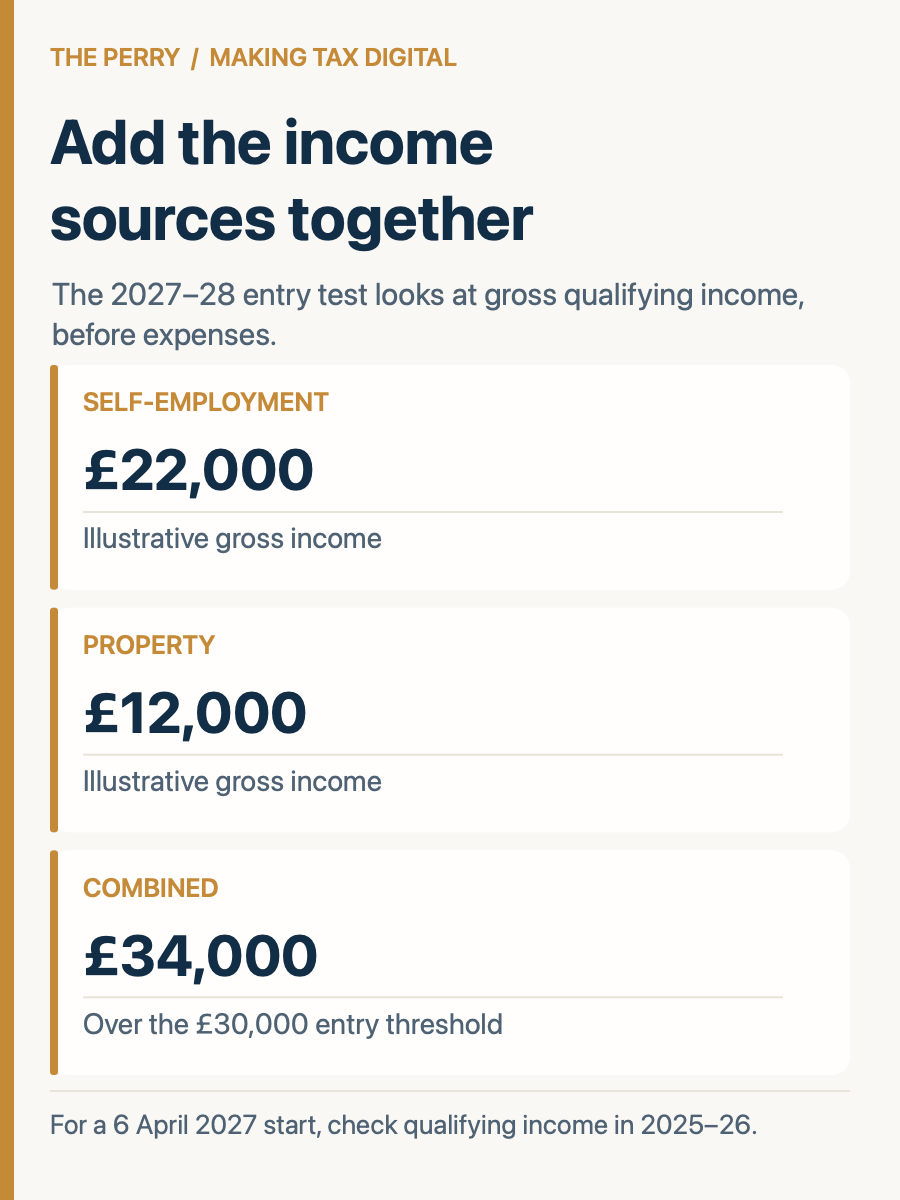
Employment income through PAYE, dividends, pensions and an individual's share of partnership profit are generally outside this qualifying-income calculation. Their tax treatment has not disappeared; where relevant they still belong on the annual return. Special situations, such as an income source that ceased after the reference-year return, need an individual check. HMRC says you must assess your position even if its letter does not arrive. HMRC explains what counts.
The entry timetable is worth keeping in view:
| Qualifying income shown for | Threshold exceeded | MTD start |
|---|---|---|
| 2024–25 | £50,000 | 6 April 2026 |
| 2025–26 | £30,000 | 6 April 2027 |
| 2026–27 | £20,000 | 6 April 2028 |
These figures are more than thresholds, rather than automatic entry at the exact number. Partnerships have a separate future timetable. HMRC's current entry guidance is the place to check unusual circumstances or possible exemptions.
2. Understand what changes during the year
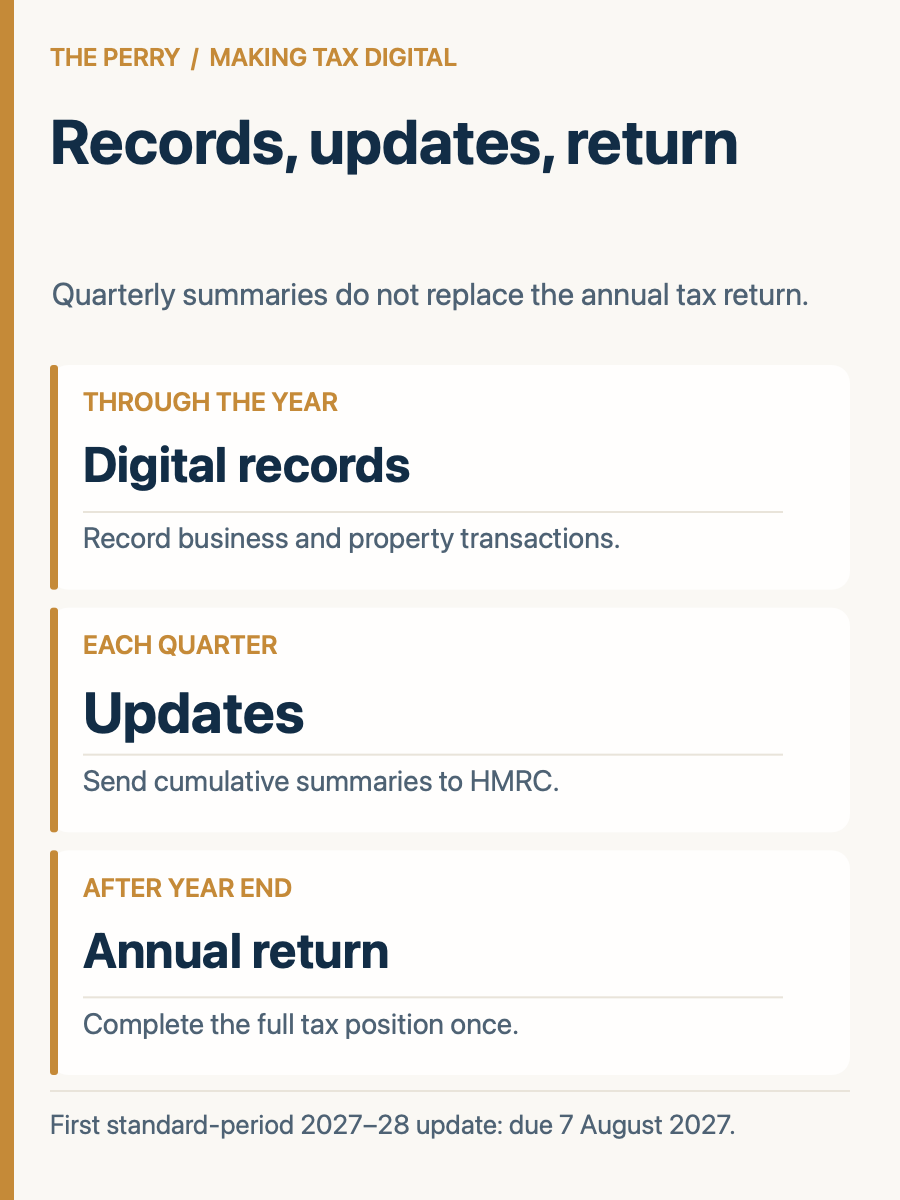
MTD means keeping digital records of your self-employment and property income and expenses with compatible software. You or an authorised agent then send quarterly summaries to HMRC. Those updates are not four tax returns, and HMRC does not require you to make every year-end accounting or tax adjustment before each update. You still complete one annual tax return, add other relevant income and reliefs, and pay tax under the usual payment rules. HMRC's first-year guide explains the distinction.
For standard tax-year update periods, the first update covers 6 April to 5 July 2027 and is due 7 August 2027. Later deadlines are 7 November 2027, 7 February 2028 and 7 May 2028. If your accounts run from 1 April to 31 March, calendar update periods may suit you better; the submission deadlines are the same. Choose the update basis in your software before the first update. Each standard-period update reports totals from the start of the tax year to the end of that period, so it is cumulative rather than simply three new months of figures. See HMRC's update periods and deadlines.
Your 2025–26 return is still due by 31 January 2027 under the existing route. Your first MTD tax year will be 2027–28, with its annual return and payment deadline on 31 January 2029 under the current rules. MTD does not replace the return for the year before you join. HMRC's Self Assessment deadlines and MTD first-year guidance cover the handover.
3. Choose software around your records, not a sales pitch
Start by mapping what you actually record: number of trades, jointly owned properties, invoices, bank accounts, overseas income and any other items needed for the annual return. Then check whether one product handles digital records, quarterly updates and the annual return. Some people will prefer accounting software that stores transactions. Others can continue with suitable spreadsheets linked to compatible bridging software. If you use more than one product, make sure the products exchange the information needed to complete all submissions. HMRC's software guide explains the options.
Look beyond the subscription price. Test whether the software supports every income source you have, your update period, corrections, an agent's access and exports of your underlying records. HMRC maintains a software finder; check its current listing and the provider's exact feature set. A free plan may work for a simple case but should not be assumed to cover a more complex return.
4. Make the transition manageable
Before April, reconcile the 2025–26 return to the income sources you will carry into MTD. Decide who will enter transactions, how paper receipts will be captured, and how often bank records will be checked. Separate business and personal spending as consistently as possible. A system that leaves three months of unclear transactions until the filing week will make each quarterly update harder than it needs to be.
Then set four reminders in a calendar and leave time for review before each submission. If an accountant files for you, agree in advance who owns the records, what they will receive, and how you will handle corrections. Keep the supporting invoices and records as required; a submission confirmation does not replace them.
A useful pre-April check: (1) confirm whether 2025–26 qualifying income exceeds £30,000; (2) list each trade and property source; (3) choose compatible software; (4) check the first digital-record date and update basis; (5) agree a monthly review routine; (6) sign up through HMRC's current process before your start date.
Common questions
My profit is below £30,000. Am I outside MTD? Not necessarily. The threshold is based on gross qualifying income before expenses. Check all relevant self-employment and property sources together.
Does a quarterly update create a new tax payment? It is an information update, not a new quarterly income-tax payment. Your annual bill and any payments on account still need separate attention.
Can my accountant do this for me? An authorised agent can maintain records and submit updates, but you still need a reliable way to provide complete information and understand the deadlines.
The rules above are general UK information, checked on 4 November 2026. If your income sources, residence or exemptions are unusual, use HMRC's checker or obtain advice on your particular position before signing up.
Official sources
- HMRC: find out if and when you need MTD for Income Tax
- HMRC: work out qualifying income
- HMRC: quarterly update periods and deadlines
- HMRC: choose compatible software
The Perry's source and corrections policy.
A moment for your view
What did you think?
Your feedback helps us choose what to explain next.
One reaction per article each day from your connection. Reactions are shared privately with the editor. Send a correction or a message →
How feedback is recorded
We keep article reaction totals and a temporary coded check based on your internet connection to limit repeated submissions. The check expires within 24 hours and is removed by scheduled cleanup. This feature stores no names, email addresses, cookies or browser storage, and sends no data to an outside feedback service. People using the same connection may share the daily limit.