Category: Professional

  • Will AI Replace Accountants and Bookkeepers? The Skills That Matter Next


    Will AI Replace Accountants and Bookkeepers? The Skills That Matter Next

    About this article This article is personal, general commentary. It does not represent or carry the endorsement of any employer, ICAEW, AAT or another professional body; it is not accounting, tax, legal, investment, employment or data-protection advice; and it creates no adviser–client relationship. No client or employer information has been used. Verify current rules and obtain advice appropriate to your circumstances before acting.

    Professional learning pathway for future accounting skills.
    Professional learning pathway for future accounting skills. Original AI-generated illustration prepared for The Perry using OpenAI image generation. No human photographer; no people or real client data depicted.

    It is understandable that accountants and bookkeepers ask whether AI will replace them. The more useful question is which tasks will change and which capabilities clients will value more. Routine processing will continue to shrink. At the same time, businesses will need people who can test systems, resolve exceptions, understand regulation and explain what the numbers mean.

    ACCA’s Alistair Brisbourne says: “Professionals who can embrace uncertainty, develop strong judgement skills, and continuously adapt their expertise will thrive.”

    Tasks are not the same as jobs

    A role is a bundle of activities. AI may draft an email, suggest a coding or summarise a variance, but the accountant still gathers context, checks evidence, handles ambiguity and accepts responsibility. As automation takes more of the first pass, entry-level work must be redesigned so that people still learn how transactions flow through the records and how errors appear.

    ICAEW’s 2025 international research supports that concern: 85% of respondents tended to agree or strongly agreed that trainees still need hands-on technical accounting work. We should not allow efficient tools to create professionals who can operate software but cannot recognise when it is wrong.

    Four skills that increase in value

    • Professional judgement: assessing evidence, materiality, uncertainty and the limits of an automated conclusion.
    • Communication: turning analysis into a clear recommendation and discussing uncomfortable issues with clients or colleagues.
    • Data and control literacy: understanding where data comes from, who can change it, how a model is monitored and what an audit trail shows.
    • Ethical courage: challenging an attractive output when it conflicts with confidentiality, fairness, objectivity or the public interest.
    Calculator and open technical textbook.
    Calculator and open technical textbook. Photo: Anoushka Puri / Unsplash. Free to use under the Unsplash Licence; source and licence checked 29 August 2026.

    AAT’s employer research found AI and automation among the most critical future finance skills, alongside forecasting, cybersecurity and data analysis. Those subjects belong together. Using AI responsibly requires more than knowing how to write a prompt; it requires an understanding of the financial process and the risks around it.

    What firms should do now

    Training should combine tool use with technical review. Give staff safe examples, an approved-use policy and a clear escalation route. Ask them to verify outputs against source documents and explain their reasoning. Keep junior staff involved in reconciliations, accounts preparation and client conversations so that automation supports learning rather than bypassing it.

    My view

    AI is likely to replace portions of work that are repetitive and easy to specify. It is also likely to create new work in assurance, governance, data quality and system oversight. Accountants who rely only on processing may find their role narrowing. Those who combine sound technical foundations with curiosity, scepticism and the ability to advise will remain valuable.

    The future is not accountant versus machine. It is accountable professionals using machines well — and knowing when not to use them.

    Minimal office calculator.
    Minimal office calculator. Photo: 404 (@unsplash_official) / Unsplash. Free to use under the Unsplash Licence; source and licence checked 29 August 2026.

    Continue reading on The Perry

    References and further reading

  • Client Data, Confidentiality and AI: A Risk Checklist for Accountants

    Client Data, Confidentiality and AI: A Risk Checklist for Accountants

    About this article This article is personal, general commentary. It does not represent or carry the endorsement of any employer, ICAEW, AAT or another professional body; it is not accounting, tax, legal, investment, employment or data-protection advice; and it creates no adviser–client relationship. No client or employer information has been used. Verify current rules and obtain advice appropriate to your circumstances before acting.

    Secure financial documents and digital privacy.
    Secure financial documents and digital privacy. Original AI-generated illustration prepared for The Perry using OpenAI image generation. No human photographer; no people or real client data depicted.

    Financial records contain some of the most sensitive information a client can provide: names, addresses, bank details, payroll data, tax identifiers and commercially confidential results. That makes data handling the first question in any accounting AI project, not an item to consider after the tool has been purchased.

    Confidentiality still applies

    The professional principles have not changed because a new interface makes processing convenient. ICAEW links the use of generative AI to integrity, objectivity, professional competence and due care, confidentiality and professional behaviour.

    ICAEW’s guidance is direct: “being transparent and honest in the use of Generative AI is essential”.

    In practical terms, staff should not paste client records, tax questions with identifying details, payroll extracts or unpublished accounts into an unapproved public chatbot. Removing a client’s name may not be enough if the remaining information can identify the individual or business.

    Questions to ask before use

    • Purpose: What defined task is the system performing, and is all the proposed data necessary?
    • Lawful handling: What is the lawful basis for processing personal data, and does the privacy information cover the use?
    • Provider terms: Is input retained, used to train models, transferred internationally or accessible to subcontractors?
    • Security: Are access controls, multi-factor authentication, encryption, logging and deletion arrangements adequate?
    • Accuracy and rights: Can an output be corrected, explained and challenged before it affects a person?
    • Exit: Can the organisation retrieve and delete its information if it changes provider?
    Blank working paper, calculator and pen.
    Blank working paper, calculator and pen. Photo: Mediamodifier / Unsplash. Free to use under the Unsplash Licence; source and licence checked 29 August 2026.

    GOV.UK summarises the continuing duties clearly: organisations must keep personal information secure, accurate and up to date, and tell people how it is used and shared. AI does not suspend those obligations.

    Use the minimum data

    A sensible design starts with data minimisation. Test prompts with fictitious or anonymised examples. Where a task only requires totals, do not provide transaction-level personal information. Separate client datasets and restrict access to those who need it. For higher-risk processing, consider whether a data protection impact assessment is required and obtain appropriate advice.

    Keep a human in the decision

    Where AI contributes to a recommendation or a decision affecting an individual, the reviewer must do more than click “approve”. Meaningful review requires access to the underlying evidence, authority to disagree and enough expertise to recognise an implausible answer. The ICO and Alan Turing Institute guidance on explaining AI-assisted decisions is particularly relevant here.

    My rule is simple: if I would not be comfortable explaining the data flow, the checks and the final conclusion to the client, I would not use the system for that task. Trust is easier to preserve than to rebuild.

    Calculator on a neutral surface.
    Calculator on a neutral surface. Photo: Behnam Norouzi / Unsplash. Free to use under the Unsplash Licence; source and licence checked 29 August 2026.

    Continue reading on The Perry

    References and further reading

  • From Bookkeeping to Better Decisions: AI Forecasting and Advisory Work

    From Bookkeeping to Better Decisions: AI Forecasting and Advisory Work

    About this article This article is personal, general commentary. It does not represent or carry the endorsement of any employer, ICAEW, AAT or another professional body; it is not accounting, tax, legal, investment, employment or data-protection advice; and it creates no adviser–client relationship. No client or employer information has been used. Verify current rules and obtain advice appropriate to your circumstances before acting.

    Cash-flow and scenario forecasting workspace.
    Cash-flow and scenario forecasting workspace. Original AI-generated illustration prepared for The Perry using OpenAI image generation. No human photographer; no people or real client data depicted.

    The most promising use of AI in accounting is not faster data entry. It is the opportunity to turn well-kept records into earlier, more useful conversations. If technology can identify a weakening margin, a cash-flow pinch or an unusual spending pattern before the month-end meeting, the accountant can spend more time helping the owner decide what to do.

    What AI adds to forecasting

    AI-assisted tools can analyse historic sales, payment behaviour, seasonality and cost patterns. They can refresh forecasts more frequently and model alternative assumptions. For a growing business, that may expose a funding gap earlier; for a retailer, it may highlight the cash effect of stock decisions; for a service firm, it may show the impact of delayed billing or recruitment.

    ACCA says the direction of travel includes “an expansion in strategic and advisory decision-making.” That is an opportunity, but it also raises the standard of judgement expected from the accountant.

    A forecast is not a fact

    Every forecast is conditional. Historic patterns may be a poor guide after a price increase, the loss of a major customer or a change in regulation. An AI model can also hide assumptions behind a simple chart. Before presenting the result, I would ask what data was used, what period it covers, which variables matter, how outliers were treated and what happens under a downside case.

    This is where professional experience adds value. A business owner may know that a contract is at risk, a supplier is changing terms or a one-off order will not recur. The ledger does not automatically contain that context.

    Calculator, books and pen for financial analysis.
    Calculator, books and pen for financial analysis. Photo: Recha Oktaviani / Unsplash. Free to use under the Unsplash Licence; source and licence checked 29 August 2026.

    A practical advisory routine

    • Start with reconciled and timely bookkeeping; sophisticated analysis cannot repair unreliable source records.
    • Agree the decision the forecast is intended to support, such as hiring, borrowing or dividend planning.
    • Show a base case and at least one downside case, with the assumptions written in plain English.
    • Compare each forecast with actual results and investigate material variances.
    • Record where AI assisted the analysis and ensure the final commentary is reviewed by the accountant.

    ICAEW’s global research emphasises critical thinking alongside privacy, data security, ethics and client relationships. That combination is telling. Better software does not reduce the need for an accountant who can challenge an output and explain uncertainty without hiding behind technical language.

    The human advantage

    Clients rarely need another dashboard. They need a conversation that connects the figures to choices: collect debts sooner, change pricing, delay expenditure, obtain finance or accept a period of lower margin. AI can help find signals and test scenarios. The accountant must decide which signals deserve attention, communicate the limitations and relate the numbers to the client’s objectives.

    Used on that basis, AI can strengthen advisory work. It does not replace the trusted adviser; it gives that adviser a faster route from transactions to questions worth asking.

    Calculator on working papers.
    Calculator on working papers. Photo: FIN / Unsplash. Free to use under the Unsplash Licence; source and licence checked 29 August 2026.

    Continue reading on The Perry

    References and further reading

  • AI Bookkeeping Automation: Saving Time Without Losing Control

    AI Bookkeeping Automation: Saving Time Without Losing Control

    About this article This article is personal, general commentary. It does not represent or carry the endorsement of any employer, ICAEW, AAT or another professional body; it is not accounting, tax, legal, investment, employment or data-protection advice; and it creates no adviser–client relationship. No client or employer information has been used. Verify current rules and obtain advice appropriate to your circumstances before acting.

    Abstract exception review in automated bookkeeping.
    Abstract exception review in automated bookkeeping. Original AI-generated illustration prepared for The Perry using OpenAI image generation. No human photographer; no people or real client data depicted.

    Bookkeeping contains exactly the sort of work that automation handles well: repeated formats, high transaction volumes and rules that can be stated in advance. That makes it an excellent place to begin with AI. It also makes overconfidence dangerous, because a small coding error repeated hundreds of times can distort management information and tax records.

    Where automation earns its keep

    Modern tools can read supplier invoices, suggest ledger codes, identify duplicate documents, match bank transactions and flag entries that do not fit the usual pattern. In a clean, stable process, this can reduce manual keying and allow the bookkeeper to focus on exceptions.

    An AAT member described a sensible division of labour: “Bank rules need to be absolutely right.” The system can suggest matches, but the practitioner checks and trains the process.

    That is the practical model I favour. Let the system handle the first pass; let a trained person decide whether the evidence supports the accounting treatment.

    The errors to expect

    AI can confuse similar suppliers, infer the wrong VAT treatment, repeat an error in historical data, or match a payment to the wrong invoice. It may also produce a confident explanation that does not agree with the underlying document. These are not reasons to reject automation. They are reasons to design controls around predictable failure modes.

    Calculator and laptop used for financial work.
    Calculator and laptop used for financial work. Photo: Jakub Żerdzicki / Unsplash. Free to use under the Unsplash Licence; source and licence checked 29 August 2026.

    Five controls I would retain

    • Approval thresholds: require human approval for new suppliers, unusual journals, high-value items and changes to standing rules.
    • Exception queues: review low-confidence matches, duplicates, missing evidence, unusual VAT codes and transactions outside normal patterns.
    • Reconciliations: reconcile bank, receivables, payables and control accounts independently of the automated posting process.
    • Audit trail: retain the original document, proposed treatment, final decision and identity of the reviewer.
    • Periodic sampling: test apparently successful transactions as well as exceptions; silent systematic errors may otherwise go unnoticed.

    ACCA’s work on how AI is reshaping finance emphasises that automation remains constrained by operational, control, cost and data considerations. A gradual implementation is therefore good practice. A parallel run gives the business a baseline, reveals misclassifications and allows rules to mature before reliance increases.

    Measure quality, not just speed

    A time saving is only valuable if the records remain accurate and reviewable. I would track the proportion of transactions accepted without change, the type and value of corrections, time spent resolving exceptions and whether month-end closes sooner. If automation merely moves work from entry to investigation, the process needs redesign.

    The aim is not bookkeeping without bookkeepers. It is bookkeeping in which routine handling is lighter and professional attention is directed towards the entries that carry judgement, risk or commercial significance.

    Calculator, pen and paper.
    Calculator, pen and paper. Photo: Aaron Lefler / Unsplash. Free to use under the Unsplash Licence; source and licence checked 29 August 2026.

    Continue reading on The Perry

    References and further reading

  • AI in Accounting and Bookkeeping: A Practical Guide for UK Businesses

    AI in Accounting and Bookkeeping: A Practical Guide for UK Businesses

    About this article This article is personal, general commentary. It does not represent or carry the endorsement of any employer, ICAEW, AAT or another professional body; it is not accounting, tax, legal, investment, employment or data-protection advice; and it creates no adviser–client relationship. No client or employer information has been used. Verify current rules and obtain advice appropriate to your circumstances before acting.

    AI-assisted accounting workspace with abstract financial information.
    AI-assisted accounting workspace with abstract financial information. Original AI-generated illustration prepared for The Perry using OpenAI image generation. No human photographer; no people or real client data depicted.

    Artificial intelligence is no longer a distant prospect for the accounting profession. It is already present in bank-feed matching, invoice capture, anomaly detection, forecasting, spreadsheet review and the drafting of routine communications. In my experience, the best results come when we treat AI as an assistant: useful for speed and pattern recognition, but never the person accountable for the figures.

    What do we mean by AI accounting?

    The label covers several different technologies. Some are rule-based and predictable; others learn patterns from data; generative AI produces text or summaries from prompts. That distinction matters. A bank rule that follows an agreed instruction is not the same as a chatbot that can produce a plausible but incorrect answer.

    For a small business, the most useful applications are usually modest: extracting details from invoices, suggesting transaction categories, matching receipts to payments, highlighting unusual entries, preparing a first draft of a cash-flow commentary, or turning an accountant’s notes into a clearer client email.

    ACCA’s Alistair Brisbourne puts the professional challenge neatly: “new dynamics are being introduced to the traditional trust mechanisms that underpin the accountancy profession.”

    The advantages — and the boundary

    Used well, AI can shorten repetitive work, improve consistency and bring exceptions to the accountant’s attention earlier. That creates more time to ask the questions that matter: Why has margin changed? Is cash tight because customers are paying slowly? Is the forecast based on realistic assumptions?

    Calculator, laptop and office table.
    Calculator, laptop and office table. Photo: Jakub Żerdzicki / Unsplash. Free to use under the Unsplash Licence; source and licence checked 29 August 2026.

    The boundary is accountability. Software does not know the full commercial context, cannot accept professional responsibility and may not explain how it reached an answer. I would not allow an AI-generated journal, tax conclusion, forecast or client recommendation to pass into final use without a competent person checking the source data, assumptions and output.

    A sensible starting point

    • Choose one low-risk, repetitive process rather than attempting a wholesale transformation.
    • Use approved business tools and do not paste identifiable client data into a public AI service.
    • Define what the human reviewer must check and retain evidence of that review.
    • Measure time saved, corrections required and whether the output genuinely improves client service.
    • Stop or redesign the process if errors are difficult to detect or explain.

    AAT’s practical reporting shows accountants using AI to support reconciliation, identify discrepancies and improve communications. That is a realistic picture: incremental gains rather than an autonomous finance department.

    My conclusion

    AI will become part of ordinary accounting software, much as cloud bookkeeping did. The firms and businesses that benefit most will not be those that automate everything first. They will be those that combine clean data, well-designed controls and professional scepticism with technology that solves a defined problem. The accountant’s role remains central: to test the evidence, explain the numbers and take responsibility for the advice.

    Minimal calculator workspace.
    Minimal calculator workspace. Photo: charlesdeluvio / Unsplash. Free to use under the Unsplash Licence; source and licence checked 29 August 2026.

    Continue reading on The Perry

    References and further reading

  • Working from home when self-employed: simplified expenses or actual costs?

    Working from home when self-employed: simplified expenses or actual costs?

    Working from home creates a deceptively simple tax question: if the home is also a workplace, how much of its cost belongs to the business?

    For a UK sole trader, there are usually two broad approaches. Simplified expenses use a monthly flat rate based on hours worked at home. The actual-cost approach identifies relevant household costs and applies a reasonable business proportion. Neither method is automatically best. The useful choice is the one that is available, supportable and proportionate to the amount involved.

    This is general information, not individual tax advice. Company directors, employees, partnerships with corporate partners and people with unusual property arrangements can face different rules.

    Option one: simplified expenses

    Laptop and calculator used for a financial calculation
    Photo by Jakub Żerdzicki on Unsplash

    HMRC’s simplified working-from-home rates apply when a self-employed person works at home for at least 25 hours in a month. The current published monthly rates are:

    • 25 to 50 hours: £10
    • 51 to 100 hours: £18
    • 101 hours or more: £26

    The attraction is administrative rather than generous tax relief. There is no need to apportion heating, electricity, Council Tax, rent or mortgage interest individually. A defensible record of hours is still needed.

    The flat rate does not cover the business proportion of telephone or internet bills. Those costs can be considered separately using a reasonable method. Simplified expenses are not available to every structure: HMRC limits them to sole traders and business partnerships with no corporate partner.

    Option two: actual costs

    Business records being reviewed beside a calculator
    Photo by Kelly Sikkema on Unsplash

    The alternative is to calculate the business share of relevant household expenses. HMRC lists examples including heating, electricity, Council Tax, mortgage interest or rent, and internet and telephone use.

    Only the business element is allowable. A reasonable calculation might consider:

    • the number of rooms used for work compared with the total number of usable rooms;
    • how much time the room is used for business;
    • whether the cost actually varies with business activity; and
    • any evidence that makes one room materially more expensive to run.

    There is no universal “divide everything by the number of rooms” rule. A photographer using studio lighting may consume more electricity than somebody doing bookkeeping at a desk once a week. Equally, a room used as an office for eight hours and as a family room for the rest of the day is not wholly business use.

    A simple comparison example

    Imagine a sole trader works at home for 60 hours in each of 12 months. Simplified expenses would produce £18 × 12, or £216, before separately considering qualifying telephone and internet use.

    Under actual costs, suppose the relevant annual household costs are £7,200. If a reasonable analysis supports a 5% business proportion, the claim would be £360. That does not mean actual costs “wins” by £144. The calculation must first be technically appropriate and supported by evidence, and the extra record keeping has a cost of its own.

    The numbers are illustrative only. Mortgage capital repayments are not the same as mortgage interest, private use must be excluded and some property costs raise wider considerations.

    Five common mistakes

    Claiming an arbitrary percentage

    “Ten per cent feels fair” is not a method. Keep a short note explaining rooms, hours and cost categories. A calculation does not need to be theatrical, but another person should be able to follow it.

    Treating every household bill alike

    Some costs vary with use; others do not. Internet may already have been purchased for the household at the same price, but a more expensive business package may have an identifiable business element. Look at what the cost represents.

    Forgetting private use

    Mixed use must be reflected. This is particularly important for telephone calls, broadband packages and rooms serving more than one purpose.

    Confusing sole traders with limited companies

    A limited company cannot simply use the sole-trader simplified-expenses rules. The company and the individual are separate legal persons, and the appropriate route may involve reimbursed expenses, homeworking arrangements or other considerations.

    Ignoring wider property consequences

    Exclusive business use of part of a home can affect matters beyond the annual expense claim, including Capital Gains Tax treatment and potentially business rates or insurance. Mixed use and the facts matter. Obtain advice before designating part of a home exclusively for business.

    Records worth keeping

    For simplified expenses, retain a monthly record of hours worked at home and how the rate was selected. For actual costs, retain the bills, the annual calculation and the reasoning behind the allocation. Keep evidence for separately claimed telephone and internet costs.

    Review the method when circumstances change: a house move, new office, higher energy use, a different working pattern or incorporation can all make last year’s calculation inappropriate.

    A practical decision rule

    Start by checking eligibility for simplified expenses. Then calculate both methods using supportable assumptions—not optimistic ones. Compare the tax difference with the time and uncertainty involved. A modest flat-rate claim may be entirely rational if the actual-cost benefit is small. Where home use is substantial, an evidenced actual-cost calculation may better reflect reality.

    The strongest answer is rarely the largest number. It is the number that follows the rules, matches the facts and can still be explained two years later.

    Further reading on The Perry

    Browse this section

    Move naturally through the Professional articles or jump back to the section overview.

    Back to Professional

    Previous in Professional

    Read previous

    Making Tax Digital for Income Tax in 2026: a practical first-year checklist

    Next in Professional

    You are at the end of this section.

    Sources and further reading

    Source check: 23 August 2026. Verify current HMRC guidance before acting.

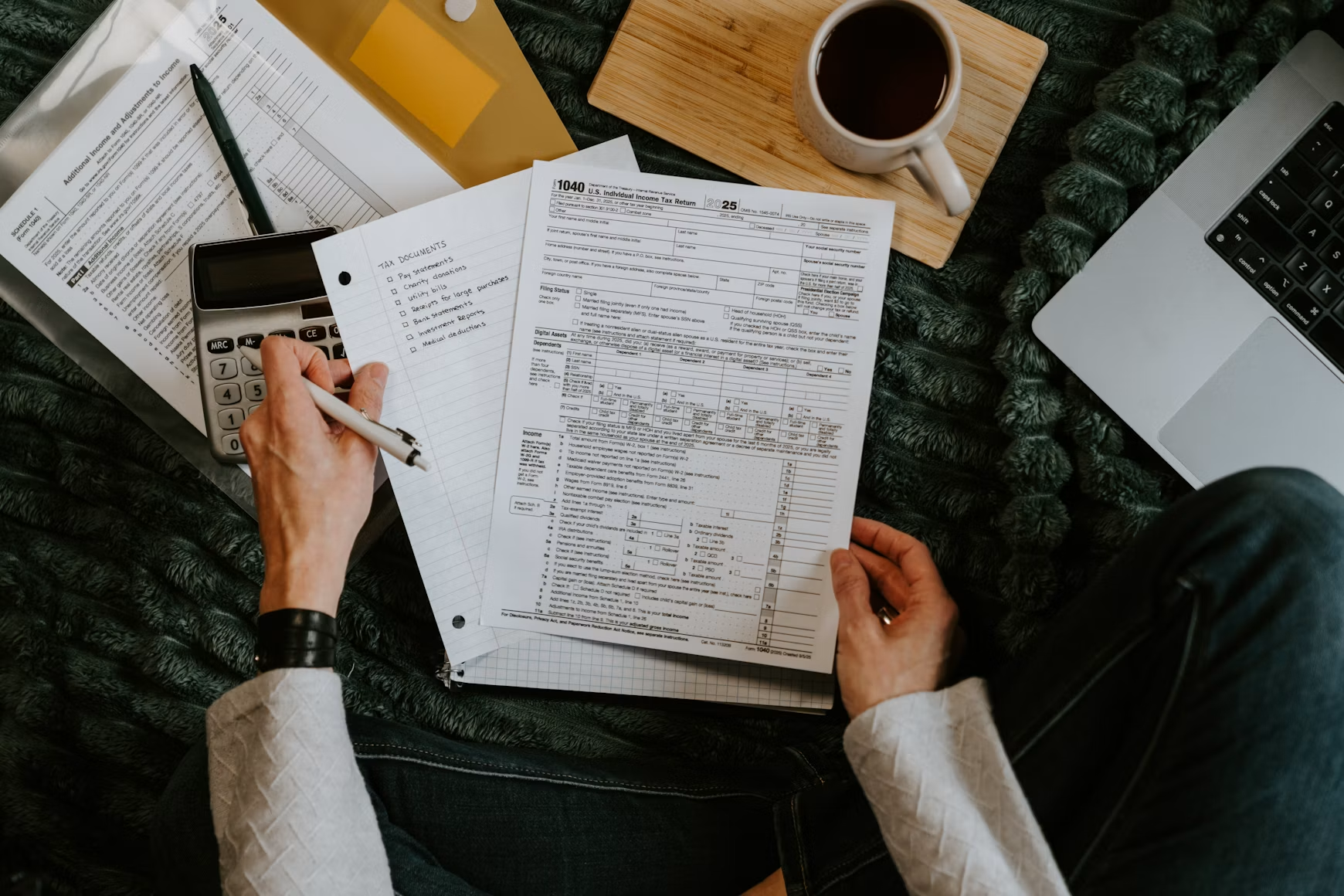
    Featured image credit: Photo by Sasun Bughdaryan on Unsplash.

  • Making Tax Digital for Income Tax in 2026: a practical first-year checklist

    Making Tax Digital for Income Tax in 2026: a practical first-year checklist

    Making Tax Digital for Income Tax moved from a future change to a live obligation on 6 April 2026. For the first group of sole traders and landlords, bookkeeping software is now part of the route through Self Assessment rather than an optional convenience.

    The basic idea sounds simple: keep digital records, send HMRC summaries during the year and complete the tax return through compatible software. The practical work sits underneath those words. A business needs to know whether it is in scope, which income counts towards the threshold, how each activity is represented in software and who is responsible for checking the final figures.

    This article is general information, not individual tax or accounting advice. HMRC guidance changes, so follow the linked source material and check the position that applies to you before acting.

    Who had to start in April 2026?

    Laptop and calculator arranged on a working desk
    Photo by Jakub Żerdzicki on Unsplash

    The first mandatory group consists broadly of individuals already within Self Assessment who receive income from self-employment or property and whose qualifying income for 2024–25 was more than £50,000.

    “Qualifying income” is turnover before expenses, not taxable profit. It combines gross self-employment and property income. That distinction matters: a landlord or sole trader with modest profit can still cross the threshold because the test is based on income before costs.

    HMRC’s published timetable then lowers the threshold in stages: more than £30,000 from April 2027, based on the 2025–26 return, and more than £20,000 from April 2028, based on the 2026–27 return. Partnerships and limited companies are not brought into this Income Tax regime merely because they use accounting software; the rules described here concern qualifying individuals.

    The four moving parts

    Paperwork being checked with a calculator at a home desk
    Photo by Kelly Sikkema on Unsplash

    1. Digital records

    Income and expense records must be created and stored in software that works with Making Tax Digital. The record normally needs the amount, date and category of each transaction. Digital record keeping does not remove the need to retain supporting material such as invoices and bank statements.

    The sensible operational question is not simply “Do we own software?” It is “Where does each transaction first enter the system, and how is it checked?” Bank feeds reduce typing but do not decide whether an item is business, private, capital or revenue. Automation moves work; it does not remove judgement.

    2. Quarterly updates

    HMRC’s published standard deadlines for the first mandatory year are:

    • first quarterly update: 7 August 2026;
    • second quarterly update: 7 November 2026;
    • third quarterly update: 7 February 2027; and
    • fourth quarterly update: 7 May 2027.

    These dates come directly from HMRC’s first-year MTD timetable. The updates are summaries of income and expenses from the digital records. They are not four miniature tax returns, but they still depend on records being complete enough to produce a meaningful submission.

    HMRC has said it will not apply penalty points for late quarterly updates in 2026–27. That easement does not remove the obligation, and the updates must still be sent before the return can be completed.

    3. Year-end review and the tax return

    Quarterly submissions are not the end of the process. After the tax year, the records must be reviewed and adjusted. Other income and gains may need to be added, and reliefs or allowances considered. The taxpayer then submits the tax return through compatible software and pays by the normal 31 January deadline.

    This is where professional judgement remains visible. A bank transaction may be recorded correctly as £600, yet still require a decision about business use, capital treatment, VAT or deductibility.

    4. Responsibility

    An agent can help configure software, review records and submit information, but the taxpayer remains responsible for complete and accurate information. Agree responsibilities explicitly: who records cash income, checks bank-feed matches, resolves queries, closes each quarter and approves submissions?

    A practical first-year checklist

    1. Confirm scope. Check the qualifying income on the relevant return and consider whether an exemption or other special rule may apply.
    2. Choose compatible software. Test the whole journey, not just whether a product appears on a list. Consider multiple businesses, jointly owned property, bank feeds, corrections, agent access and the final return.
    3. Separate business and private activity. A dedicated business bank account is not always legally required, but it can reduce classification work and mistakes.
    4. Set an evidence routine. Decide how invoices, receipts and statements are captured, named, retained and linked to entries.
    5. Clean opening data. Duplicate contacts, uncleared old items and inconsistent categories make automation less reliable.
    6. Run a monthly review. Waiting until the quarterly deadline turns small uncertainties into a larger reconstruction exercise.
    7. Document adjustments. Keep a short explanation and evidence for corrections or unusual treatment.
    8. Plan for failure. Know who to contact if software, authorisation or a bank feed stops working near a deadline.

    The useful way to think about MTD

    Making Tax Digital is often presented as a filing change. In practice, it is a process-design change. The organisations likely to find it least disruptive are those that make record keeping routine, give exceptions to a real person to resolve and reserve enough time for review.

    The goal should not be four perfectly polished management accounts. Nor should it be four hurried button presses. It should be a dependable flow of evidence into records, records into summaries and summaries into a properly reviewed annual return.

    Further reading on The Perry

    Browse this section

    Move naturally through the Professional articles or jump back to the section overview.

    Back to Professional

    Previous in Professional

    You are at the start of this section.

    Next in Professional

    Read next

    Working from home when self-employed: simplified expenses or actual costs?

    Sources and further reading

    Source check: 23 August 2026. Tax rules and HMRC guidance can change.

    Featured image credit: Photo by Kelly Sikkema on Unsplash.