

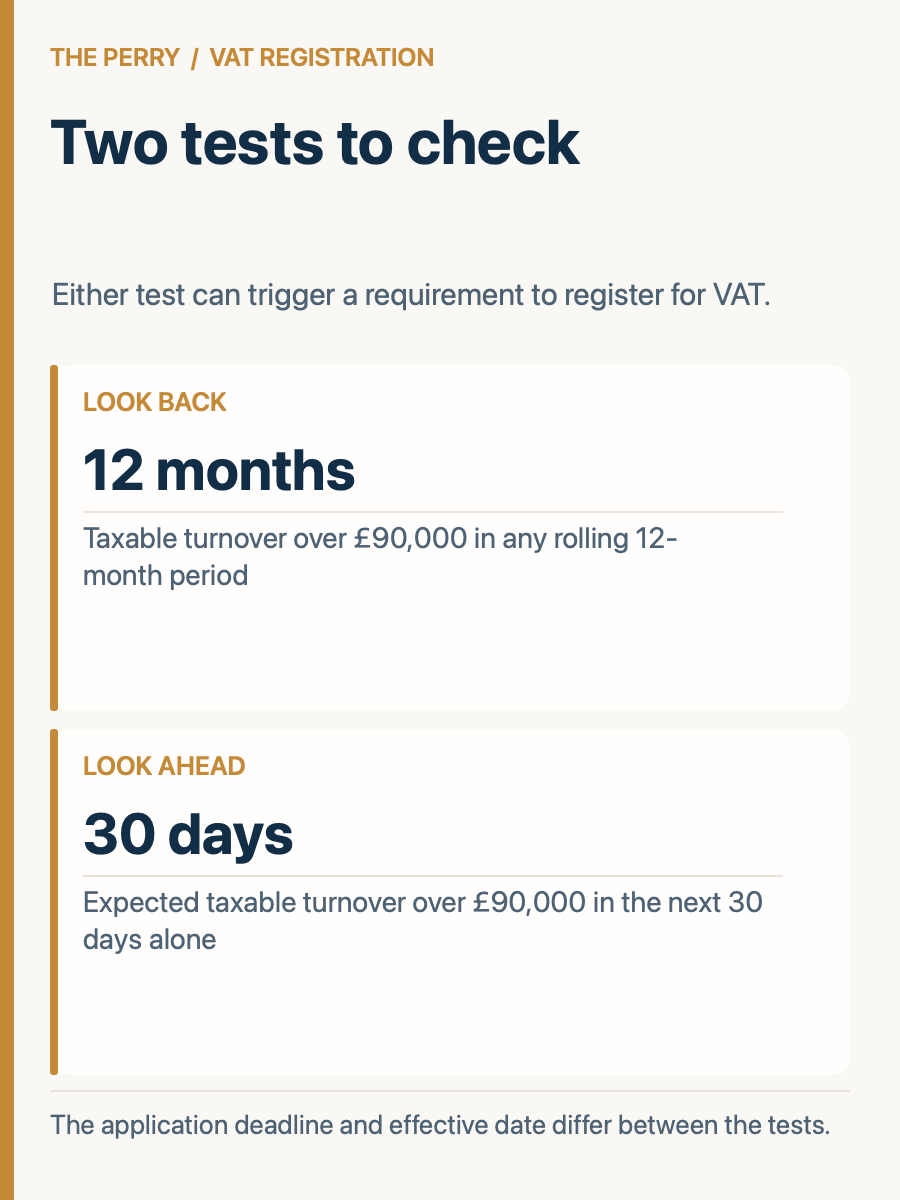
Many small businesses check their annual accounts and ask, “Have I made £90,000 yet?” For VAT, that question can miss the deadline. The usual UK registration test looks at taxable turnover in any rolling 12-month period. There is also a separate test for what you expect in the next 30 days. Profit is irrelevant to both tests.
If your sales are approaching the threshold, a simple monthly record can prevent a late registration and an unexpected VAT bill. This guide explains what to add up, when to act and what may change for customers.
The key rule: A UK-established business generally must register when its taxable turnover in the previous 12 months goes over £90,000, or it expects taxable turnover to go over £90,000 in the next 30 days. Other rules can apply to businesses without a UK establishment, acquisitions in Northern Ireland, and business transfers. HMRC: when to register.
What is “taxable turnover”?
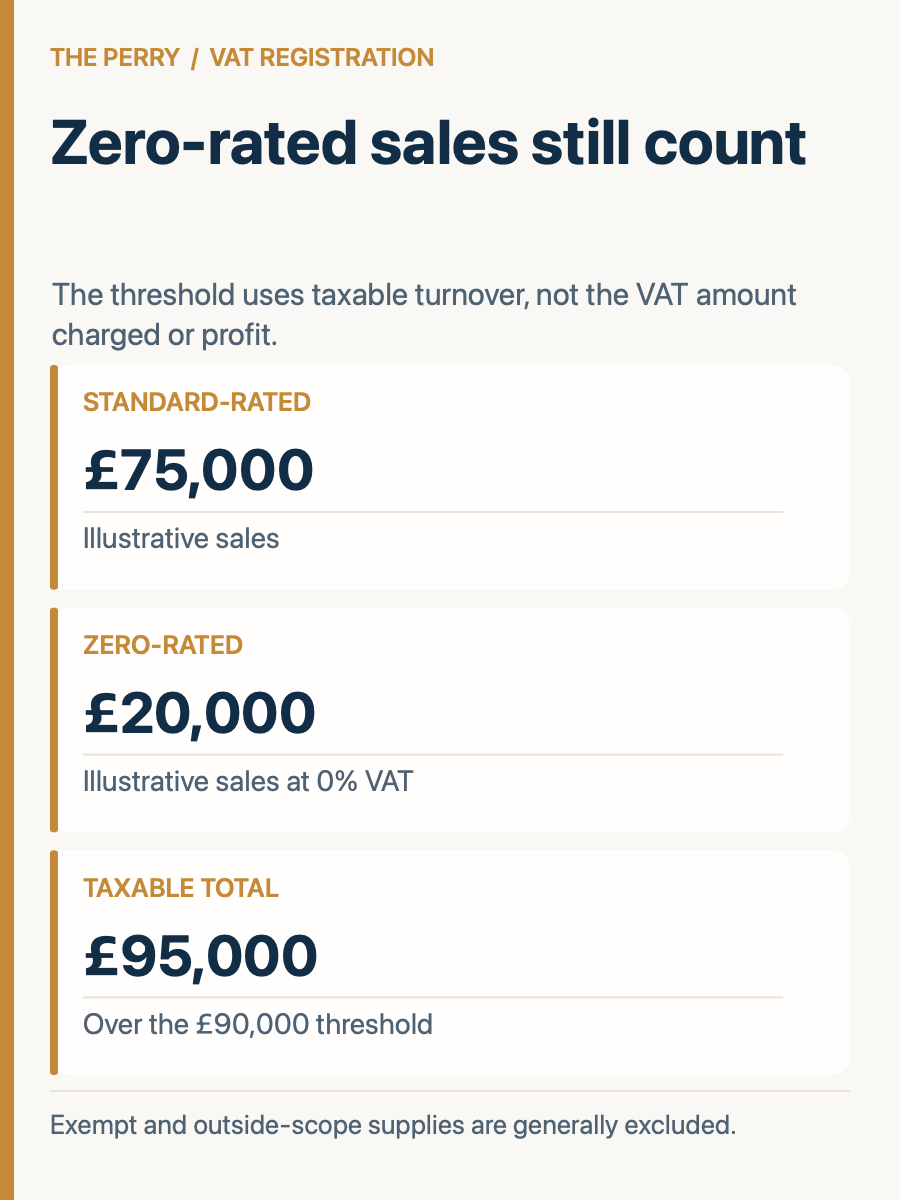
VAT taxable turnover is the value of supplies on which VAT could apply. It includes sales at the standard, reduced and zero rates. A zero-rated sale has a 0% VAT rate but still counts towards the registration threshold. Exempt and outside-the-scope supplies generally do not count. This distinction can change the answer dramatically for a business with mixed activities. HMRC's registration guidance and exemption guidance explain the categories.
For example, a business with £75,000 of standard-rated sales and £20,000 of zero-rated sales has £95,000 of taxable turnover. It cannot ignore the zero-rated £20,000 because no VAT appears on those invoices. Conversely, a business with £75,000 of taxable sales and £20,000 of genuinely exempt income does not simply add both figures for this test. Whether an item is exempt, zero-rated or outside scope depends on the facts; avoid deciding from a product label alone.
Turnover means sales, not profit after costs. It also differs from cash in the bank where timing rules affect when a supply counts. Complex cases involving imports, overseas services, reverse charges or business transfers need a more specific VAT check. Use VAT Notice 700/1 rather than relying on a general example.
The rolling 12-month check
At the end of each month, total taxable turnover for the 12 months ending then. Remove the oldest month and add the newest. This is different from checking only the calendar year or your accounting year. A business can cross the threshold in, say, August even if neither of its two financial years shows more than £90,000.
| Month-end | Taxable turnover in previous 12 months | Result |
|---|---|---|
| 30 June | £84,000 | Below the threshold; continue checking |
| 31 July | £89,500 | Still below; plan for a possible crossing |
| 31 August | £92,000 | Above £90,000; registration rule triggered |
In this illustrative August case, the usual deadline to apply is 30 September, which is 30 days from the end of the month in which the threshold was exceeded. The usual effective registration date is 1 October. The calculation is based on your real taxable supplies and their dates, so use your own records. HMRC gives the same deadline method.
The next-30-days test is different
You may need to register before the rolling total reaches £90,000 if, at a particular point, you expect taxable sales in the next 30 days alone to exceed £90,000. Think of a large one-off contract that you know will be supplied in that short period. This is not a forecast that turnover might exceed £90,000 over the next year.
Under this forward test, you must apply by the end of the 30-day period, and the effective registration date is the date you realised the threshold would be exceeded, not the invoice or payment date. HMRC's registration examples show the distinction. If a contract is unusually large, check the supply and timing rules at the point you agree it.
A monthly VAT-threshold worksheet
Keep one row for each month, using sales records that distinguish taxable supplies from exempt or outside-the-scope income. For the usual historic registration test, the figure to compare with £90,000 is taxable turnover for the latest 12 months, not profit or the balance in your bank account. Zero-rated taxable supplies still count.
| Month-end | Previous rolling total | Remove the oldest month | Add the newest month | New rolling total |
|---|---|---|---|---|
| 31 July | £88,000 | £5,000 | £6,500 | £89,500 |
| 31 August | £89,500 | £6,000 | £8,500 | £92,000 |
In the second row, the £6,000 removed is the previous August’s taxable turnover; the £8,500 added is the current August’s. The calculation is £89,500 − £6,000 + £8,500 = £92,000. Retain the underlying 12 monthly figures so the total can be checked.
Record the action as well as the number
In this illustrative UK-established-business example, crossing the historic threshold at 31 August normally means applying by 30 September, with registration effective from 1 October. Record those dates separately, along with who will make the application and where supporting records are held. An application for a temporary exception needs HMRC’s decision; a later fall in sales does not automatically cancel a registration requirement.
Also keep a separate check for the forward test: at any point, do you expect taxable turnover in the next 30 days alone to exceed £90,000? A monthly historic worksheet does not replace that test. The effective date and application deadline differ.
This is a record-keeping example, not a VAT calculation tool. It assumes the ordinary UK-established-business position; unusual supply, overseas or business-transfer circumstances need a more specific check. Verify the current threshold and deadlines against HMRC’s registration guidance before acting.
Can a temporary spike be ignored?
There is a possible exception from registration if the rolling 12-month threshold is crossed temporarily and you can demonstrate that future taxable turnover will fall below the relevant limit. It is not automatic. You must apply to HMRC, which decides and writes with its decision. Until HMRC confirms an exception, do not simply assume the business remains outside VAT. HMRC: temporary threshold excess and VAT Notice 700/1 give the process.
You may also choose voluntary registration below the threshold. That can make sense when customers can recover VAT or when input VAT is significant, but it brings returns, record-keeping and pricing obligations. Compare the commercial effect before applying. A business mainly making zero-rated supplies may in certain circumstances seek exemption from registration, again by asking HMRC rather than assuming it applies.
What changes once you register?
Registration brings an effective date, a VAT number, VAT accounting records and VAT returns. VAT may be due from the effective date even if the VAT number arrives later. Talk through pricing and invoices before that date: an agreed VAT-inclusive price may leave you bearing the VAT, while a VAT-exclusive price may affect customers who cannot recover it. Do not invent or display a VAT registration number before HMRC issues it. HMRC's registration guidance sets out the application information.
Most businesses submit VAT returns periodically and must keep appropriate digital VAT records under Making Tax Digital for VAT. Filing and payment deadlines depend on the VAT period and payment method; check the dates shown in your VAT account. HMRC: submitting VAT returns and record keeping are the starting points.
A practical monthly routine
- Classify sales as standard-rated, reduced-rated, zero-rated, exempt or outside scope, with evidence for unusual items.
- Record taxable turnover by month and calculate the latest rolling 12-month total.
- Review signed contracts for any next-30-days trigger.
- If near £90,000, model prices for VAT-registered sales and estimate the effect on customers.
- If a trigger occurs, diarise the application deadline and effective date separately, then keep records from that date.
If you crossed the threshold previously, act promptly. HMRC says a late registrant can owe VAT on sales since the date registration should have taken effect and may face a penalty. Check the official late-registration guidance rather than waiting for the next year-end accounts.
Common questions
Does zero-rated turnover count? Yes. Zero-rated supplies are taxable supplies at 0%, unlike exempt supplies.
Does the £90,000 threshold reset every April? No. The usual historic test rolls forward each month over the preceding 12 months.
If I exceed £90,000 once, can I just wait for sales to fall? No. Check whether the registration requirement has arisen. A temporary exception requires HMRC's decision.
This is general UK information, checked on 4 November 2026. VAT classification and effective dates can be fact-specific, particularly for cross-border activity and property. Check the current rules before acting.
Official sources
- HMRC: when to register for VAT
- HMRC: VAT Notice 700/1 — who should register
- HMRC: exempt and zero-rated supplies
- HMRC: VAT records
The Perry's source and corrections policy.
A moment for your view
What did you think?
Your feedback helps us choose what to explain next.
One reaction per article each day from your connection. Reactions are shared privately with the editor. Send a correction or a message →
How feedback is recorded
We keep article reaction totals and a temporary coded check based on your internet connection to limit repeated submissions. The check expires within 24 hours and is removed by scheduled cleanup. This feature stores no names, email addresses, cookies or browser storage, and sends no data to an outside feedback service. People using the same connection may share the daily limit.