

You have calculated the tax due on your 2025–26 Self Assessment return. Then you open your account and the amount payable by 31 January 2027 is larger. The extra line is often a payment on account: an advance towards the 2026–27 tax year. It is a real payment, but it is not a second charge for the same year's income.
The distinction matters for cash flow. It also helps you spot when the estimate for next year may be too high or low. This guide shows how to read the numbers and what to check before paying.
At a glance: The online 2025–26 return and any tax owed are generally due by 31 January 2027. Payments on account, where required, are usually due 31 January and 31 July. Your January statement may therefore combine a balancing payment for 2025–26 with the first advance payment for 2026–27. HMRC deadlines · HMRC payment rules.
Start with the year each amount belongs to
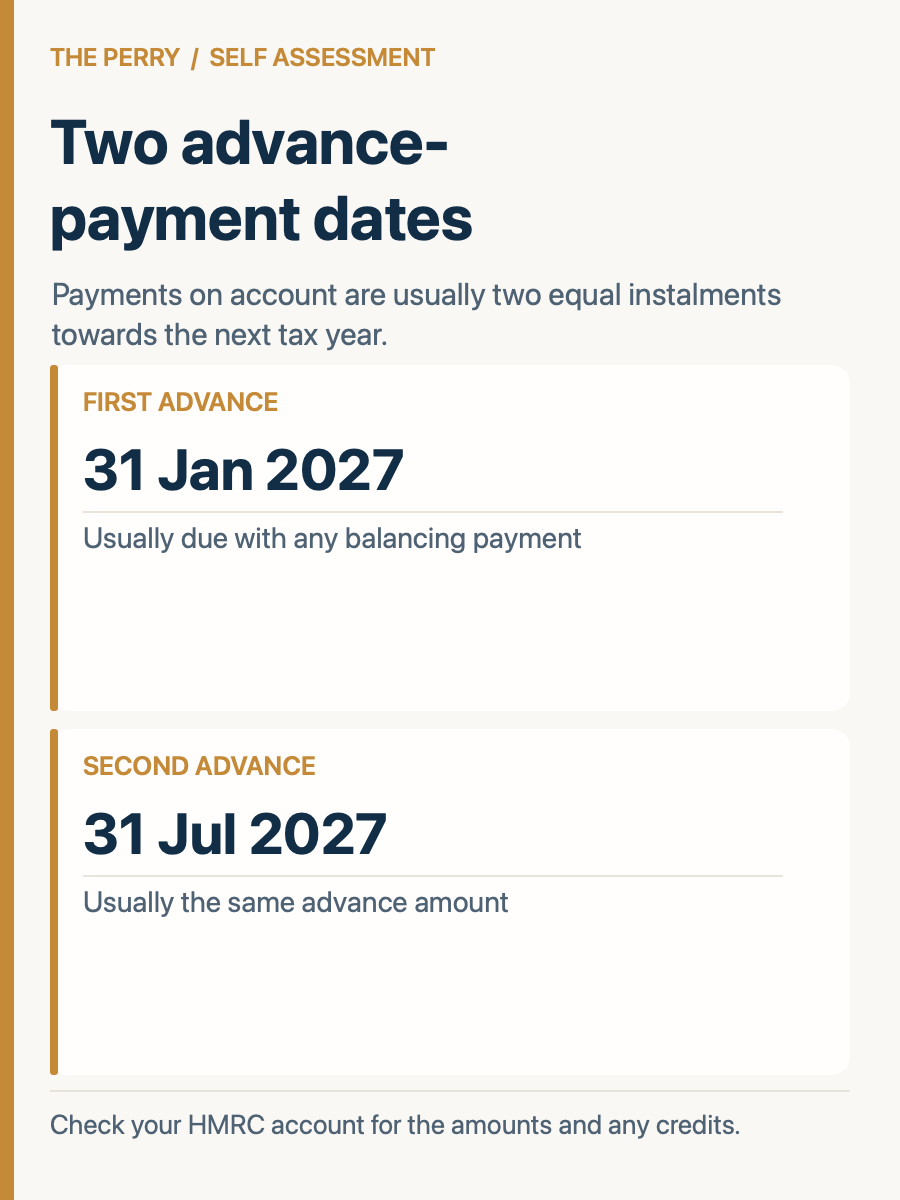
Self Assessment brings several years together on one screen. The balancing payment settles any remaining tax for 2025–26 after payments already made towards that year. The first payment on account is an estimate for 2026–27, usually based on the previous year's Self Assessment liability. A second payment on account for 2026–27 normally follows on 31 July 2027. When you eventually file the 2026–27 return, HMRC compares those two advances with the actual liability and either asks for the difference or leaves a credit.
Payments on account normally cover Income Tax and Class 4 National Insurance for a self-employed person. They are generally calculated as two equal instalments, each half of the previous year's relevant bill. Your actual Self Assessment statement is the authority for your own figures; do not infer an amount from an example in an article.
The advance-payment calculation does not include every item that can appear on a Self Assessment return. Capital Gains Tax and student or postgraduate loan repayments, for example, are dealt with in the balancing payment rather than included in the next year's payments on account. That is another reason to read the statement rather than halve the total at the bottom of a tax calculation. HMRC's calculation guidance makes these exclusions explicit.
A worked example: £3,500 due in January
Suppose your 2024–25 liability led to two payments on account of £2,000 each towards 2025–26. You paid them in January and July 2026. Your completed 2025–26 return now shows a relevant liability of £5,000. Assuming no other credits, the statement could look like this:
| What the amount does | Calculation | When due |
|---|---|---|
| Balance for 2025–26 | £5,000 actual liability − £4,000 already paid = £1,000 | 31 January 2027 |
| First advance for 2026–27 | Half of £5,000 = £2,500 | 31 January 2027 |
| Total January payment | £1,000 + £2,500 = £3,500 | 31 January 2027 |
| Second advance for 2026–27 | £2,500 | 31 July 2027 |
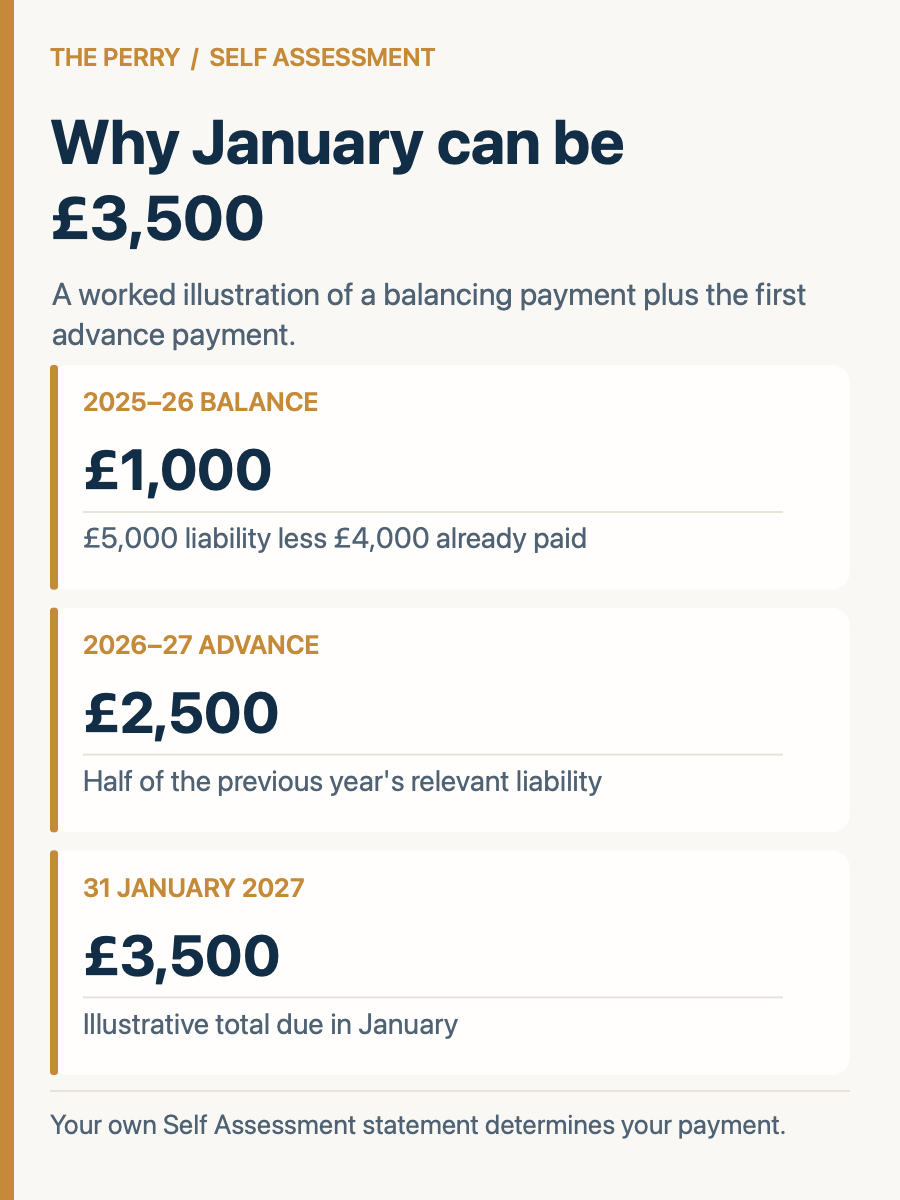
This is an illustration, not a tax calculation for a reader. A first year of Self Assessment can feel especially sharp: if you made no payments on account for 2025–26, the January payment may include the whole 2025–26 liability and the first advance for 2026–27. HMRC's worked explanation shows how credits and balances appear.
Who does not usually make payments on account?
HMRC says payments on account are generally not required if the previous year's relevant tax was less than £1,000, or more than 80% of that tax was paid outside Self Assessment, for example through PAYE. Check the wording and your statement carefully: the £1,000 test is less than, not “£1,000 or less”. A taxpayer with £1,000 exactly may still need payments on account if the other exception does not apply. See HMRC's exceptions.
If you have employment and self-employment income together, tax deducted from salary can change whether payments on account apply. The calculation may also be affected by credits and other items. The safe approach is to inspect the statement line by line rather than assume that everyone who files a return has the same payment pattern.
What if next year's income will be lower?
You can ask HMRC to reduce your payments on account if you reasonably expect your next year's relevant liability to be lower. A change in trading income, a lost rental source or a move into employment could justify reviewing the estimate. Keep a simple calculation explaining your revised forecast and the assumptions behind it. Do not reduce the payments just to ease a temporary cash shortage if you expect the tax itself to remain due.
If you reduce them too far, HMRC can charge interest on the shortfall. If income later improves, review the estimate again and pay more before interest builds. The option is a way to make advances reflect a reasonable tax estimate, not a way to cancel the eventual bill. HMRC: reduce payments on account.
Three dates to put in your calendar
For the 2025–26 return, the ordinary paper filing deadline was 31 October 2026, so it has passed. The online filing and payment deadline is 31 January 2027. If you qualify to have a small bill collected through your tax code, the online return normally needs to be filed by 30 December 2026 for that option. A later filing deadline given to someone who registered after 5 October does not automatically move the 31 January payment deadline. HMRC sets out these dates.
The second payment on account is due 31 July 2027 if your statement requires one. Missing a deadline can lead to interest and, in some circumstances, penalties. If you cannot pay in full, check HMRC's payment-help options promptly rather than ignoring the bill.
A five-minute statement check
- Match the tax year at the top of the return to the year on each statement line.
- Confirm that previous payments on account and credits have been applied.
- Separate the balance for 2025–26 from the first advance for 2026–27.
- Check whether the 31 July 2027 instalment is shown and put it in your cash forecast.
- If 2026–27 income has genuinely changed, calculate whether a reasonable reduction is appropriate before requesting one.
Filing early gives you longer to plan, even though it does not move the normal payment date forward. Your records should support the return and any forecast used to reduce an advance payment. For a wider view of recent tax announcements, see The Perry's UK Budget 2026 overview; distinguish announced future measures from the rules for the return you are filing now.
Common questions
Is a payment on account an extra tax? No. It is a credit against the next tax year's eventual bill. It is still cash you must find by the due date if HMRC has assessed it.
Can I simply pay only the balance from my return? Check the statement. If a payment on account is due, paying only the balancing amount may leave an overdue advance and interest.
Will Making Tax Digital replace these payments? No. HMRC says MTD changes records and reporting for people within scope; annual tax and payment deadlines remain.
This article gives general information, checked on 4 November 2026. Your statement, tax calculation and current HMRC guidance determine your own deadline and amount.
Official sources
- HMRC: Self Assessment deadlines
- HMRC: understand payments on account
- HMRC: what is excluded from the advance-payment calculation
- HMRC: help if you have difficulty paying
The Perry's source and corrections policy.
A moment for your view
What did you think?
Your feedback helps us choose what to explain next.
One reaction per article each day from your connection. Reactions are shared privately with the editor. Send a correction or a message →
How feedback is recorded
We keep article reaction totals and a temporary coded check based on your internet connection to limit repeated submissions. The check expires within 24 hours and is removed by scheduled cleanup. This feature stores no names, email addresses, cookies or browser storage, and sends no data to an outside feedback service. People using the same connection may share the daily limit.