

The Companies House identity-verification rules are now in operation. For many small companies, the difficult part is not proving a person's identity once. It is working out which company role needs the personal code, which filing carries it and when that filing is due. A director who is also a person with significant control (PSC) has two separate role requirements.
This guide explains the process for an individual director or PSC in an ordinary UK company. It does not cover every corporate-director, overseas-company or protected-information case. For your actual deadline, use the Companies House register and the current official timing guidance.
The short answer: Verify your identity through GOV.UK One Login or an Authorised Corporate Service Provider (ACSP). You receive a personal code. Then use that code for each relevant director or PSC role in the required filing or service. Verification itself and reporting the code for a role are separate steps. Companies House: verify your identity · personal-code guidance.
First, list the roles you hold
For each company, note whether you are a director, a PSC, or both. A PSC is someone meeting a significant-control condition, such as holding more than 25% of shares or voting rights; other control conditions can also apply. Your company record should identify the roles currently recorded. If it is inaccurate, the company should correct the register through the proper filing route rather than trying to solve the problem by sending an identity code to the wrong role. Companies House explains PSCs.
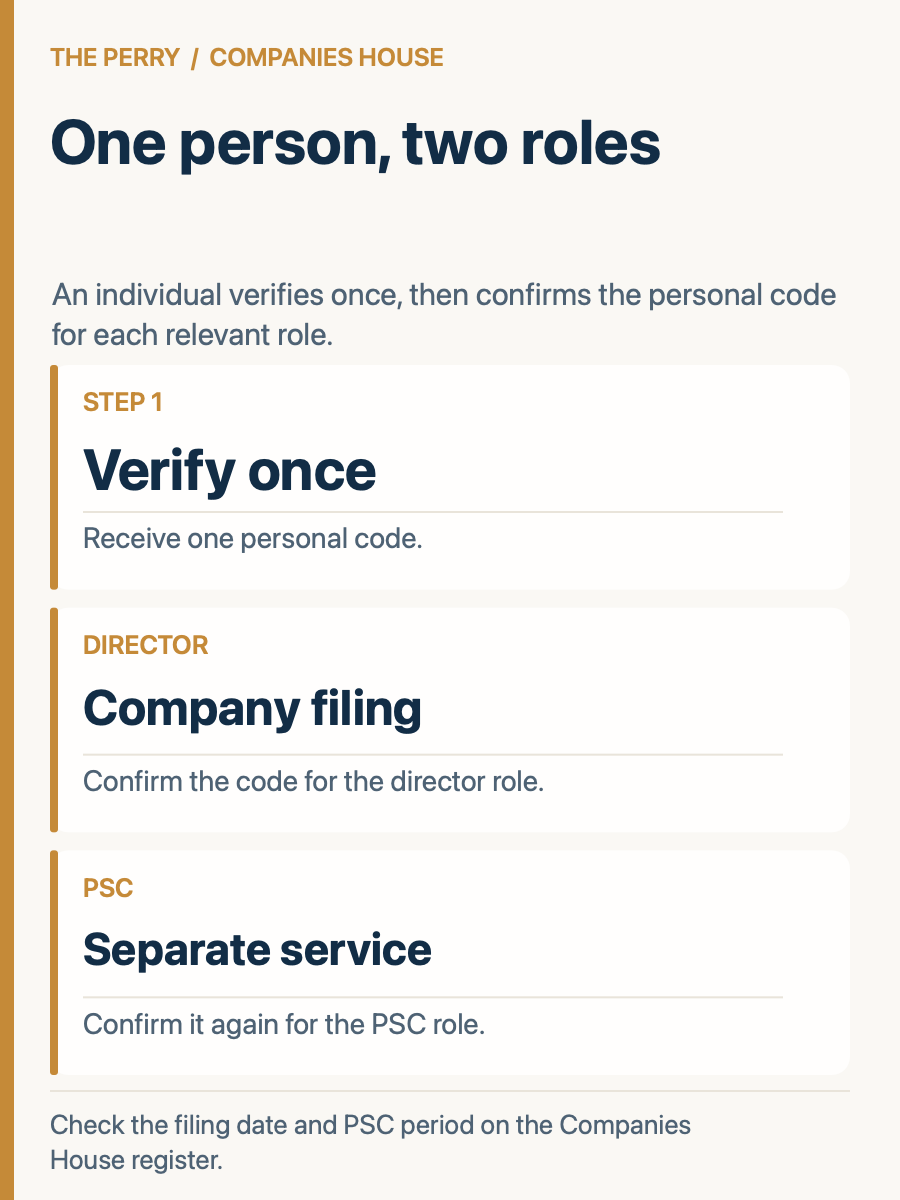
An individual generally verifies their identity once and receives one personal code. The same code can then be used for different companies and appointments. What repeats is the need to confirm the code for each applicable role. This is especially easy to overlook in a one-person company: entering the code as a director does not automatically complete the separate PSC step. Companies House: personal codes.
The route depends on the role
| Your role | Where the code normally goes | Timing to check |
|---|---|---|
| Existing director | The company's next confirmation statement | The statement filing date shown for the company |
| New director | Appointment filing or incorporation filing | At the appointment or incorporation stage |
| Existing PSC who is also a director | A separate PSC identity-details service as well as the director step | A 14-day window starting the day after the company's confirmation statement date |
| Existing PSC who is not a director of that company | PSC identity-details service | First 14 days of the PSC's birth month |
| Person becoming a PSC after 18 November 2025 | Code when added to the register, or within 14 days after | Check the recorded addition date |
The table summarises Companies House's role-by-role guidance. The register shows the particular PSC verification dates. Do not publish a person's birth date or personal code on your website merely to explain a deadline.
There is one subtle point for a director who is also a PSC: if the company files its confirmation statement early, that does not move the PSC's 14-day window. Check the company's confirmation statement date rather than calculating the PSC date from an early filing. Companies House gives the rule.
How to verify your identity
The direct route uses GOV.UK One Login. Companies House says this route is free. The service explains which identity documents and additional details you need and what alternative routes are available if an online check does not work. You can also use an ACSP, such as an accountant or solicitor registered to carry out the check. Ask whether the firm is registered as an ACSP and what it charges before giving it documents. A professional's general qualifications alone do not make them an ACSP.
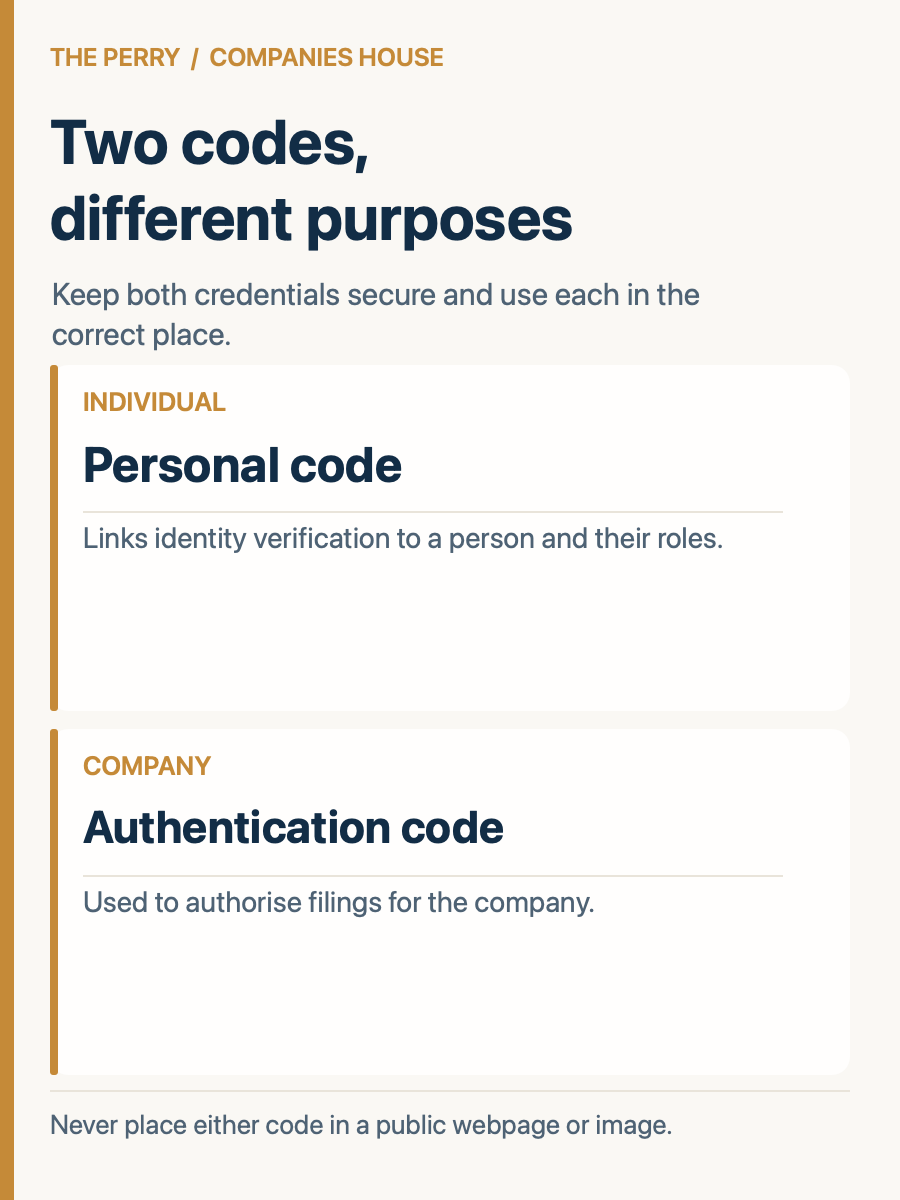
After successful verification, Companies House provides an 11-character personal code. It belongs to you, not the company, and is different from the company's authentication code. You may share it with a trusted person filing on your behalf, but keep it out of public documents and ordinary email threads where it is not needed. Companies House explains how to retrieve it from your account; for verifications after 8 July 2026, it also says it emails the code. Official code guidance.
A small-company example
Imagine a company with two directors. One director also owns 60% of the shares and is recorded as a PSC. Both directors verify and give their personal codes for the company's next confirmation statement. The 60% shareholder must also provide the code through the separate PSC service during the correct 14-day window. The other director has no PSC step unless they meet a PSC condition too.
This example shows the workflow, not a determination of someone's legal status. Share structures and control arrangements can be more complicated than one shareholding percentage. The company's filing history and register entries are the starting evidence.
Avoid the two common mistakes
Mistake one: “I verified, so I am finished.” Verification produces the code; it does not necessarily report it for every appointment. After verification, check each company and each role, then confirm that the appropriate filing or PSC service accepted the code.
Mistake two: following a link in an alarming email. Companies House identity checks have created an opportunity for impersonation. Open GOV.UK and the Companies House register directly from a known address. Do not enter a code, password or identity-document details into a page reached through an unexpected message. Companies House has scam-reporting guidance.
A five-step check before the due date
- Search your company on the official Companies House register and list each director and PSC role you hold.
- Note the confirmation statement date and any PSC verification period shown on the register.
- Verify through GOV.UK One Login or a verified ACSP, and store the personal code securely.
- Agree who will file the director and PSC details; if one person handles both, make sure they know these are separate steps.
- Read back the filing confirmation and the register status for each role.
If a deadline has passed, use the current Companies House instructions promptly. Do not assume the 12-month transition period that began on 18 November 2025 gives every person the same final day. The relevant date is tied to the role and company record. Companies House rollout announcement and timing guidance explain the schedule.
Common questions
I am a director of two companies. Do I verify twice? Usually no. You verify once and use the same personal code for each relevant director appointment, but each company's filing still needs to confirm the code.
I am both director and PSC. Is one filing enough? No. The director code goes in the company's confirmation statement, while the PSC code is provided separately through the PSC service.
Is my personal code the company's authentication code? No. The personal code identifies a verified individual; the company authentication code is a different filing credential.
This article gives general information, checked on 4 November 2026. Companies House may change its services and guidance. Check the register and current official instructions for each role before filing.
Official sources
- Companies House: when you need to verify
- Companies House: verify your identity
- Companies House: personal codes
- Companies House: report impersonation scams
The Perry's source and corrections policy.
A moment for your view
What did you think?
Your feedback helps us choose what to explain next.
One reaction per article each day from your connection. Reactions are shared privately with the editor. Send a correction or a message →
How feedback is recorded
We keep article reaction totals and a temporary coded check based on your internet connection to limit repeated submissions. The check expires within 24 hours and is removed by scheduled cleanup. This feature stores no names, email addresses, cookies or browser storage, and sends no data to an outside feedback service. People using the same connection may share the daily limit.