
You can be tired all evening, get into bed expecting to fall asleep — and suddenly your brain begins a meeting you never scheduled.
A conversation from three days ago. Tomorrow’s workload. Something you forgot. Something that probably will not happen. Then the thought that you must sleep now joins the discussion.
If that sounds familiar, the useful goal is not to “empty your mind”. It is to stop giving every worry unlimited access to bedtime.
Featured photograph by Mauri Studio on Unsplash · View original and licence
Quick answer: Move problem-solving earlier, write worries down, give solvable problems a next action, create a predictable wind-down, and stop trying to force sleep. NHS Every Mind Matters specifically recommends writing worries down, using a short daily “worry time”, keeping a regular sleep routine and getting out of bed to do something relaxing if sleep will not come.
Why does everything feel louder at night?
Worry, stress and anxiety can make it harder to sleep. Bedtime also removes many of the ordinary tasks that occupied your attention during the day.
That does not mean every racing thought is a mental-health disorder. Poor sleep happens to many people from time to time.
The practical problem begins when bed becomes the place where you repeatedly do your planning, reviewing, arguing and catastrophising.
The solution is to give those jobs somewhere else to happen.
1. Give worrying an appointment
This sounds counter-intuitive, but “do not worry” is not a useful instruction.
NHS Every Mind Matters suggests setting aside a short 10–15 minute “worry time” each day, before bed, to write concerns down and think about possible solutions.

Photo by Suzanne Rushton on Unsplash · View original and licence
Try this:
At 7:30pm: write down everything your mind keeps reopening.
For each item, ask:
- Is this a real problem I can do something about?
- Is it a hypothetical “what if” worry?
- Does it need action tonight?
- If not tonight, exactly when will I deal with it?
Then stop at 10–15 minutes.
The point is not to solve your life in a notebook. It is to teach your brain: we have a place for this, and it is not 1:17am.
2. Turn solvable worries into a next action
“Sort finances” is not a plan.
“Check bank balance tomorrow at 6pm” is.
“Deal with work” is not a plan.
“Send the missing-document email at 9:15am” is.
NHS problem-solving guidance recommends separating practical problems from hypothetical worries and making plans specific: what you will do, how and when.
The smaller the next action, the less work your memory has to do overnight.
3. Write tomorrow down before your head hits the pillow
If you keep remembering things in bed, create a tomorrow list before your wind-down starts.
Keep it short:
- 3 things that actually need doing;
- any appointment or deadline;
- one thing you are deliberately not dealing with tomorrow.
That last line matters. Not everything deserves promotion to urgent.
Once it is written, you no longer need to rehearse it so you will not forget it.
4. Build a “landing strip” before sleep
Going straight from emails, social media, household jobs or work into bed gives your brain very little transition.
NHS sleep guidance recommends a calm routine and suggests avoiding phones, tablets and computers for about an hour before bed.
You do not need an elaborate wellness ritual. Build something repeatable:
60 minutes before bed: finish stimulating tasks and reduce screens.
30 minutes before: shower, read, stretch, listen to quiet music or prepare for tomorrow.
Bedtime: bedroom cool, dark and quiet; phone away rather than beside your face.
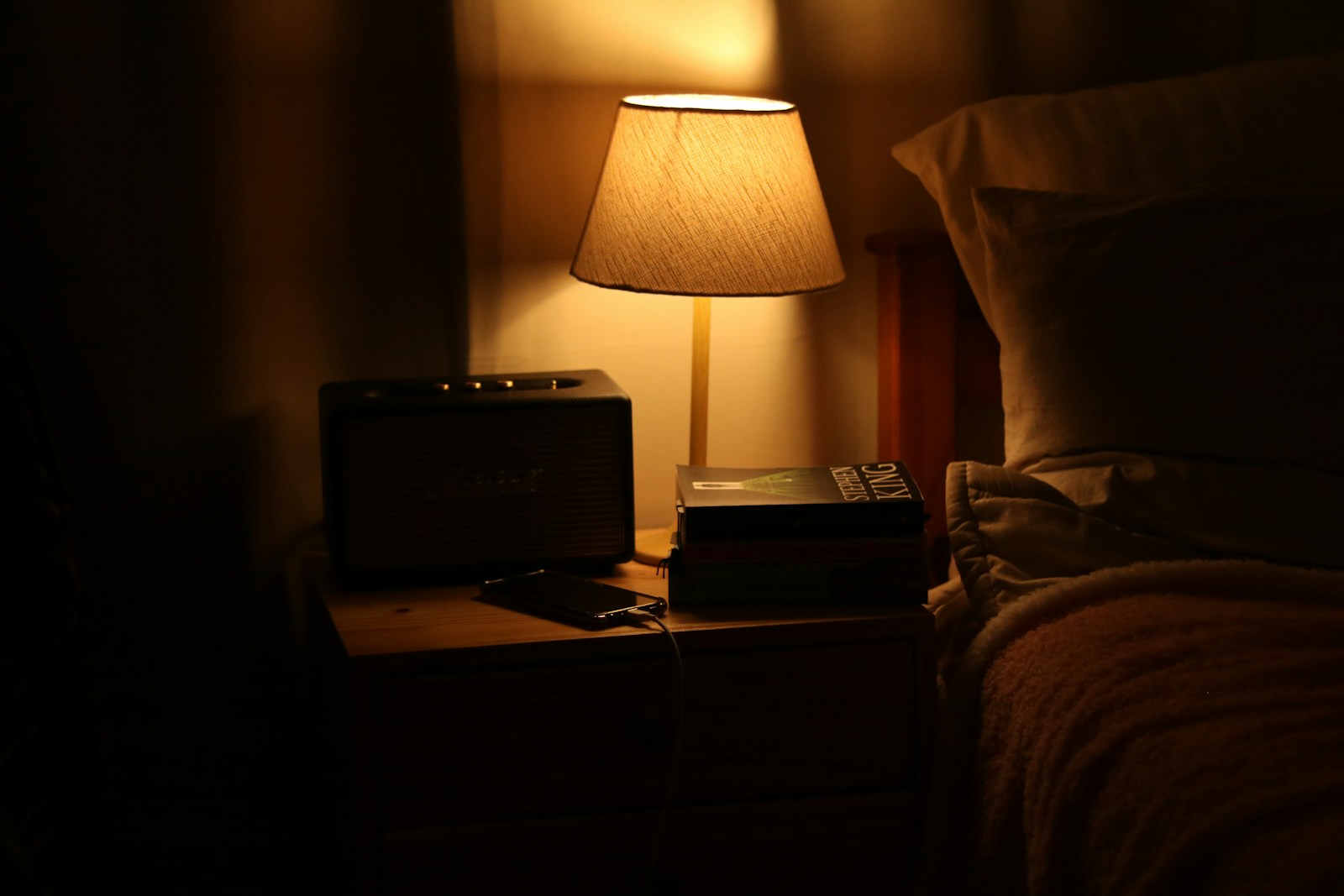
Photo by Alicia Christin Gerald on Unsplash · View original and licence
Consistency matters more than making the routine perfect.
5. Do not turn sleep into a performance test
One of the quickest ways to make bedtime stressful is to calculate how badly tomorrow will go if you are not asleep in the next nine minutes.
NHS advice is straightforward: do not force sleep.
If you are lying awake and cannot sleep, get up, sit somewhere comfortable and do something relaxing such as reading or listening to quiet music. Return to bed when you feel sleepier.
The objective changes from:
“I must make myself sleep.”
to:
“I can rest and let sleep arrive when I am sleepy.”
That is a much less demanding job.
6. Check what you are feeding the problem during the day
Bedtime is not isolated from the previous 16 hours.
NHS guidance notes that caffeine, alcohol, nicotine, large meals close to bed, inconsistent sleep times and lack of routine can all affect sleep.
You do not need to change everything at once.
Pick one experiment for a week:
- move your last caffeine earlier;
- keep wake-up time more consistent;
- get regular daytime activity;
- move heavy meals away from bedtime;
- keep the phone out of bed.
Then judge what changed.
7. When a thought comes back, do not reopen the whole case
You wrote it down. You decided whether it was solvable. You made a plan.
When it returns at night, try a short response:
“Already captured. Tomorrow at 10.”
Then return attention to something neutral: your breathing, the physical feeling of the bed, quiet audio or the page you are reading.
This is not about proving the thought wrong. It is about refusing to hold the same meeting twice.
Try this tonight: the 15-minute reset
5 minutes — empty your head
Write down worries, tasks and loose ends.
5 minutes — sort them
Action tomorrow / later / not controllable.
3 minutes — make tomorrow concrete
Choose the first one to three actions.
2 minutes — close the day
Put the list away and start your normal wind-down.
If another worry arrives in bed, add one line only if necessary. Do not restart the session.
What if this keeps happening?
Occasional poor sleep is common. But the NHS advises speaking to a GP if you regularly struggle to fall asleep, stay asleep or wake too early and changes to sleep habits are not helping.
If persistent anxiety is affecting everyday life, NHS mental-health services and NHS Talking Therapies may also be appropriate depending on your circumstances.
This article is practical wellbeing information, not a diagnosis or substitute for individual medical advice.
If anxiety is attached to one particular activity, our practical guide to driving anxiety shows how a gradual confidence plan can work in a real-world situation.
The bottom line
You do not need a perfectly quiet mind to sleep.
You need to move planning out of bed, reduce unfinished loops, give worry a boundary and stop treating sleep as a task you can force.
Tonight, do not try to solve everything.
Write it down. Decide what deserves action. Give tomorrow a short list.
Then let bedtime be bedtime.