
Working from home creates a deceptively simple tax question: if the home is also a workplace, how much of its cost belongs to the business?
For a UK sole trader, there are usually two broad approaches. Simplified expenses use a monthly flat rate based on hours worked at home. The actual-cost approach identifies relevant household costs and applies a reasonable business proportion. Neither method is automatically best. The useful choice is the one that is available, supportable and proportionate to the amount involved.
This is general information, not individual tax advice. Company directors, employees, partnerships with corporate partners and people with unusual property arrangements can face different rules.
Option one: simplified expenses

HMRC’s simplified working-from-home rates apply when a self-employed person works at home for at least 25 hours in a month. The current published monthly rates are:
- 25 to 50 hours: £10
- 51 to 100 hours: £18
- 101 hours or more: £26
The attraction is administrative rather than generous tax relief. There is no need to apportion heating, electricity, Council Tax, rent or mortgage interest individually. A defensible record of hours is still needed.
The flat rate does not cover the business proportion of telephone or internet bills. Those costs can be considered separately using a reasonable method. Simplified expenses are not available to every structure: HMRC limits them to sole traders and business partnerships with no corporate partner.
Option two: actual costs
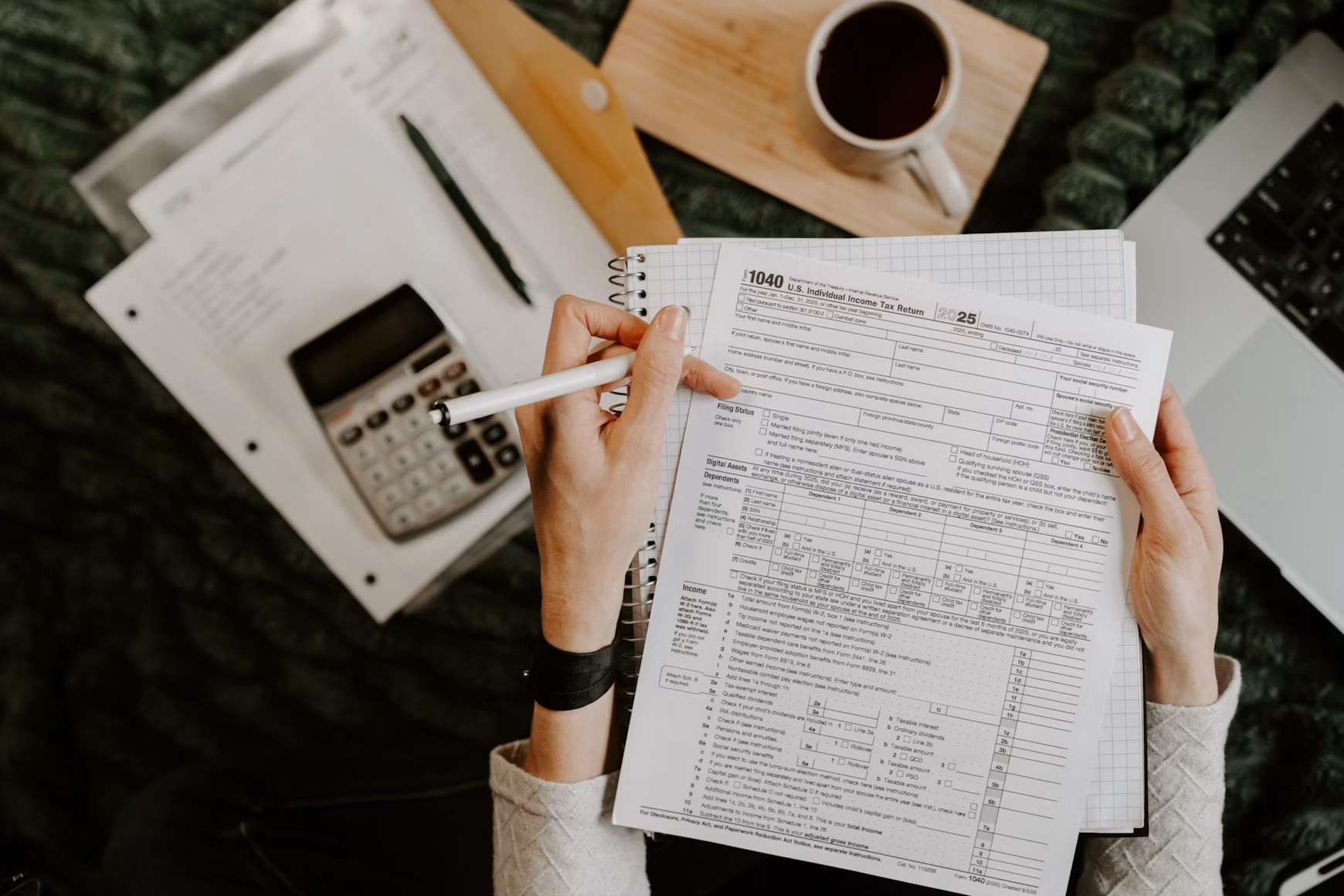
The alternative is to calculate the business share of relevant household expenses. HMRC lists examples including heating, electricity, Council Tax, mortgage interest or rent, and internet and telephone use.
Only the business element is allowable. A reasonable calculation might consider:
- the number of rooms used for work compared with the total number of usable rooms;
- how much time the room is used for business;
- whether the cost actually varies with business activity; and
- any evidence that makes one room materially more expensive to run.
There is no universal “divide everything by the number of rooms” rule. A photographer using studio lighting may consume more electricity than somebody doing bookkeeping at a desk once a week. Equally, a room used as an office for eight hours and as a family room for the rest of the day is not wholly business use.
A simple comparison example
Imagine a sole trader works at home for 60 hours in each of 12 months. Simplified expenses would produce £18 × 12, or £216, before separately considering qualifying telephone and internet use.
Under actual costs, suppose the relevant annual household costs are £7,200. If a reasonable analysis supports a 5% business proportion, the claim would be £360. That does not mean actual costs “wins” by £144. The calculation must first be technically appropriate and supported by evidence, and the extra record keeping has a cost of its own.
The numbers are illustrative only. Mortgage capital repayments are not the same as mortgage interest, private use must be excluded and some property costs raise wider considerations.
Five common mistakes
Claiming an arbitrary percentage
“Ten per cent feels fair” is not a method. Keep a short note explaining rooms, hours and cost categories. A calculation does not need to be theatrical, but another person should be able to follow it.
Treating every household bill alike
Some costs vary with use; others do not. Internet may already have been purchased for the household at the same price, but a more expensive business package may have an identifiable business element. Look at what the cost represents.
Forgetting private use
Mixed use must be reflected. This is particularly important for telephone calls, broadband packages and rooms serving more than one purpose.
Confusing sole traders with limited companies
A limited company cannot simply use the sole-trader simplified-expenses rules. The company and the individual are separate legal persons, and the appropriate route may involve reimbursed expenses, homeworking arrangements or other considerations.
Ignoring wider property consequences
Exclusive business use of part of a home can affect matters beyond the annual expense claim, including Capital Gains Tax treatment and potentially business rates or insurance. Mixed use and the facts matter. Obtain advice before designating part of a home exclusively for business.
Records worth keeping
For simplified expenses, retain a monthly record of hours worked at home and how the rate was selected. For actual costs, retain the bills, the annual calculation and the reasoning behind the allocation. Keep evidence for separately claimed telephone and internet costs.
Review the method when circumstances change: a house move, new office, higher energy use, a different working pattern or incorporation can all make last year’s calculation inappropriate.
A practical decision rule
Start by checking eligibility for simplified expenses. Then calculate both methods using supportable assumptions—not optimistic ones. Compare the tax difference with the time and uncertainty involved. A modest flat-rate claim may be entirely rational if the actual-cost benefit is small. Where home use is substantial, an evidenced actual-cost calculation may better reflect reality.
The strongest answer is rarely the largest number. It is the number that follows the rules, matches the facts and can still be explained two years later.
Further reading on The Perry
- Making Tax Digital for Income Tax in 2026: a practical first-year checklist
- Before you paste it into AI: a data-safety checklist for UK small businesses
- How to choose a password manager: a practical UK guide without a league table
Browse this section
Move naturally through the Professional articles or jump back to the section overview.
Previous in Professional
Making Tax Digital for Income Tax in 2026: a practical first-year checklist
Next in Professional
You are at the end of this section.
Sources and further reading
- HMRC: Simplified expenses for working from home
- HMRC: Expenses if you’re self-employed
- HMRC: Simplified expenses checker
- HMRC Business Income Manual: use of home — specific expenses
- HMRC: Income and expenses under the cash basis
Source check: 23 August 2026. Verify current HMRC guidance before acting.
Featured image credit: Photo by Sasun Bughdaryan on Unsplash.